
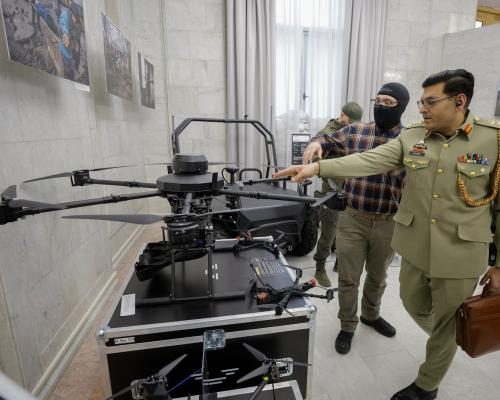
Ukrainian President Volodymyr Zelenskyy announced on Tuesday that the country is producing a surplus of up to 50% in certain types of weapons. He emphasized that military cooperation is already taking place with nations in the Middle East, the Gulf, Europe, and the Caucasus. This development marks a significant milestone in Ukraine's defense capabilities and international partnerships amid ongoing conflict.
Zelenskyy detailed that the agreements in these regions involve the production and supply of drones, missiles, and advanced technology. He noted that Kyiv has submitted a proposal to the United States for collaboration on various defense systems, specifically targeting drones and weaponry intended for use across air, land, and maritime domains. This initiative signals Ukraine's commitment to enhancing its military prowess while also fostering international defense partnerships. Originally reported by The Guardian.
Long-Range Attacks Target Russian Energy Infrastructure
As Ukraine enhances its military capabilities, it has intensified its long-range strike operations against Russian assets. On Wednesday, a fire broke out at an oil facility in Perm, located approximately 1,500 km (900 miles) from Ukraine, following what President Zelenskyy described as a successful Ukrainian drone attack. NASA's satellite fire monitoring system confirmed a significant hotspot near a cluster of tanks in the vicinity.
The Ukrainian Security Service (SBU) reported that the attack specifically targeted the Transneft pumping station as part of ongoing efforts to disrupt Russia's energy revenue streams. In addition to the incident in Perm, drone strikes on a major oil refinery in the coastal town of Tuapse caused residents to don face masks due to the plumes of black smoke that enveloped the area.
However, the conflict has not been without civilian casualties. Eight individuals sustained injuries from an attack in the Kharkiv region, and a 60-year-old woman lost her life in the Sumy region due to similar hostilities. Meanwhile, Russian forces struck Izmail in the southern Odesa region, damaging a hospital and vital infrastructure.
Escalating Tensions and Diplomatic Disputes
The war has also sparked diplomatic tensions, particularly between Ukraine and Israel. Ukraine has requested that Israel seize a cargo vessel, the Panormitis, which it claims is transporting grain looted from Russian-occupied Ukrainian territory. This vessel, flagged in Panama, is reportedly headed for Haifa. The management company based in Greece has denied the claims, asserting that the ship is not carrying any Ukrainian grain.
Israel is currently examining the evidence presented by Ukraine. Reports from the Israeli outlet Haaretz indicate that the country has been purchasing grain allegedly taken by Russia from occupied Ukrainian lands for at least two years. In response to these developments, an EU spokesperson noted that sanctions against Israeli individuals and entities aiding Russia are being considered.
Russian Economic Challenges Amid Ongoing War
The economic impact of the war is becoming increasingly apparent in Russia. Preliminary data released on Wednesday indicated that the Russian economy contracted by 0.3% in the first quarter, marking its first quarterly contraction since early 2023. Analysts attribute this downturn to the ongoing conflict, Western sanctions, and high-interest rates that have hampered economic growth.
Despite earlier signs of growth, which some analysts described as unsustainable and primarily driven by military production, the current economic climate suggests that Russian companies are struggling to invest and expand. Reports of declining profits among major Russian firms underscore the challenges posed by a key interest rate set at 14.5% and a lack of foreign investment.
International Reactions and Future Prospects
On the diplomatic front, a phone call between Russian President Vladimir Putin and former U.S. President Donald Trump raised eyebrows when they Discussed a potential temporary ceasefire in Ukraine. While Trump suggested that Putin could assist in resolving the conflict in Iran, he seemed to confuse the two situations, indicating a broader misunderstanding of the geopolitical landscape.
Additionally, North Korean leader Kim Jong-un has publicly praised soldiers who sacrificed themselves to avoid capture while fighting alongside Russian forces in the Kursk region. Reports indicate that approximately 14,000 North Korean troops have been deployed in support of Russia, with more than 6,000 reportedly killed in the fighting.
As Ukraine continues to bolster its military capabilities and engage in international partnerships, the conflict remains dynamic and fraught with geopolitical ramifications. The coming months are likely to see further developments as both military actions and diplomatic negotiations unfold in this complex landscape.
Originally reported by The Guardian. View original.