
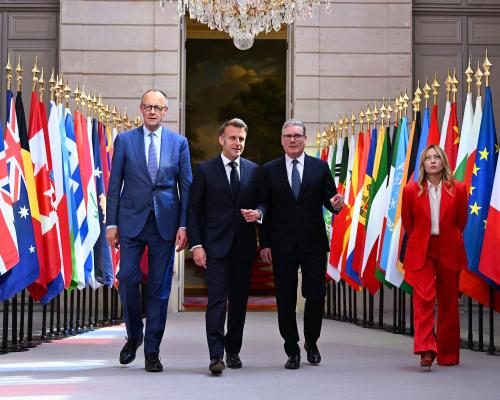
As tensions escalate between the United States and its NATO allies, European leaders are increasingly contemplating their security strategies in a potential post-American landscape. Donald Trump's controversial stance on NATO and his military decisions in Iran are prompting a significant re-evaluation of Europe's defense posture, raising alarms about the reliability of U.S. support against Russian aggression.
Trump's NATO Criticism Sparks European Security Concerns
Donald Trump's recent criticisms of NATO, branding it a "paper tiger," have sent shockwaves through European capitals. His assertions that European allies are "cowards" for not supporting the U.S.-Israeli operations in Iran have further strained transatlantic relations. This rhetoric has not only undermined NATO's credibility but has also accelerated discussions among European leaders about developing an independent security framework. Originally reported by The Guardian.
With a growing sense of urgency, European nations are beginning to take more financial and political responsibility for their own defense, particularly in light of Russia's ongoing aggression in Ukraine. Trump's apparent alignment with Moscow, especially his calls for Ukraine to concede territory, has left many European officials feeling vulnerable and questioning the reliability of U.S. military support.
Europe's Shift Towards Independent Defense Strategies
In response to these uncertainties, several European nations are reassessing their military strategies. Germany recently unveiled its first military strategy since World War II, aiming to build the strongest conventional army in Europe by 2039. Meanwhile, France is in discussions with seven non-nuclear countries to extend its nuclear deterrent, emphasizing that this initiative is meant to complement, not replace, U.S. and NATO capabilities.
Moreover, countries such as Sweden, the Netherlands, and Poland, which have historically relied on the U.S. nuclear umbrella, are exploring new deterrent measures against Russia. Although European governments are increasing their defense budgets, they face significant challenges in replicating essential military capabilities provided by the U.S., including satellite intelligence and aerial logistics.
EU's Mutual Assistance Pact Under Scrutiny
On Monday, EU ambassadors conducted a tabletop exercise to test the implementation of Article 42.7 of the EU treaty, which mandates mutual assistance among member states. This clause, more binding on paper than NATO's Article 5, has only been invoked once since its inception, following the 2015 Paris attacks. The exercise aimed to establish procedures for defense emergencies, yet it has sparked controversy among Baltic states, who fear it might embolden U.S. disengagement from European security matters.
Polish Prime Minister Donald Tusk broke a longstanding taboo by questioning whether Trump would uphold the U.S. commitment to NATO in the event of a Russian attack. He voiced concerns to the Financial Times, stating, "Europe's biggest, most important question is if the United States is ready to be as loyal as it is described in our treaties." This reflects a growing anxiety among European leaders regarding their reliance on American security guarantees.
Challenges in European Rearmament Amid Iran Conflict
The ongoing conflict in Iran presents additional challenges for European defense efforts. U.S. military engagements have significantly depleted American arsenals of critical weaponry. Consequently, European nations are facing delays in receiving essential air defense systems, long-range fire capabilities, and ammunition from U.S. defense contractors. This situation could inadvertently bolster the European defense industry, although fragmentation among manufacturers limits their ability to meet increased demand.
As a result, Europe finds itself grappling with a widening window of vulnerability, characterized by diminished U.S. support and significant capability gaps. With these pressing issues on their agenda, European leaders are likely to address their security concerns at the upcoming NATO summit in Ankara in July. However, there may be reluctance to openly discuss strategic vulnerabilities that could further strain transatlantic relations.
The trajectory of European security will depend heavily on future U.S. policies and the reliability of American commitments. As leaders navigate these complex dynamics, the shifting landscape of international relations may prompt a new era of defense strategies across Europe.
Originally reported by The Guardian. View original.