
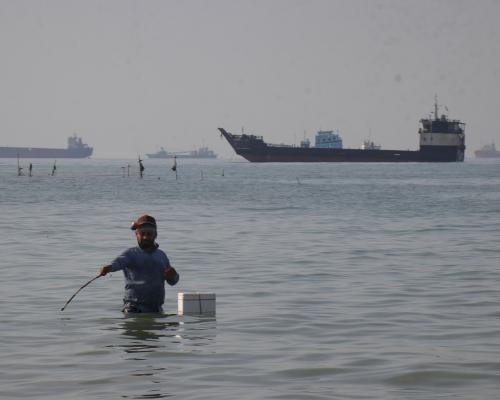
In a surprising move, former President Donald Trump has declared that the United States will take action to assist over 850 ships trapped in the Gulf due to the ongoing conflict with Iran. This initiative, dubbed "Project Freedom," aims to guide these vessels safely through the Strait of Hormuz, a crucial maritime passage, amid reportedly positive discussions between U.S. representatives and Iranian officials.
Trump made the announcement via his social media platform on Sunday, stating that the operation is intended as a humanitarian gesture not only on behalf of the U.S. but also for Middle Eastern nations, especially Iran. He emphasized, "I have told my Representatives to inform them that we will use best efforts to get their Ships and Crews safely out of the Strait." This initiative comes as the maritime industry faces mounting pressure due to the ongoing conflict, which has severely restricted shipping routes. Originally reported by The Guardian.
Details of the Operation and Iranian Response
The former president did not elaborate on the specific logistics of how the more than 850 vessels would be assisted. Reports from U.S. media indicate that the plan does not currently involve U.S. Navy warships escorting the trapped vessels. Instead, it appears to be a coordinated effort among shipping stakeholders to manage maritime traffic through the Strait of Hormuz, which has been under Iranian blockade since the onset of hostilities following a U.S.-Israeli attack on February 28.
In response to Trump's announcement, a senior Iranian official warned that any U.S. intervention in the Strait would be perceived as a violation of the established ceasefire. Iran has been adamant about maintaining its blockade on foreign shipping and has expressed that it will not allow any interference with its maritime operations. The dynamics of this situation are further complicated by a recent 14-point peace proposal from Iran, which reportedly included provisions for reopening the Strait of Hormuz.
Concerns for Trapped Sailors and Global Oil Prices
With approximately 20,000 sailors currently stranded aboard various vessels, including tankers, bulk carriers, and container ships, there are escalating concerns about their welfare. The closure of the Strait of Hormuz, a vital artery for global oil, gas, and petrochemical transport, has driven oil prices to alarming levels, surpassing $120 per barrel last week. This spike has significant implications for the global economy, particularly as nations grapple with rising energy costs.
Trump noted that countries worldwide have reached out for assistance regarding the trapped vessels. He stated on his Truth Social account, "For the good of Iran, the Middle East, and the United States, we have told these Countries that we will guide their Ships safely out of these restricted Waterways, so that they can freely and ably get on with their business." This declaration underscores the urgent need for a resolution to the maritime crisis.
Shifting Diplomatic Landscape
The backdrop of these developments includes a recent shift in diplomatic communications between the U.S. and Iran, which had been facilitated by Pakistan. Until now, there had been no direct dialogue between the two nations amidst the hostilities. Trump's optimistic tone about the potential for diplomatic progress is a marked contrast to his earlier skepticism, where he questioned whether Iran had "paid a big enough price" for its actions over the years, hinting at the possibility of renewed military strikes.
As tensions continue to simmer, the Iranian Foreign Ministry has confirmed that it received a response from Washington regarding its peace proposals, which are under review. Esmail Baghaei, spokesman for Iran's Foreign Ministry, clarified that the Iranian plan focuses on ending hostilities and does not include discussions on Iran's nuclear program at this stage. However, the U.S. maintains that any comprehensive agreement must address nuclear limitations on Iran's capabilities.
The ongoing crisis in the Gulf has implications that extend beyond regional security, affecting global oil supply chains and economic stability. As President Trump navigates these complex waters, the outcome of this initiative could have far-reaching consequences for U.S.-Iran relations and the broader Middle East.
Originally reported by The Guardian. View original.