
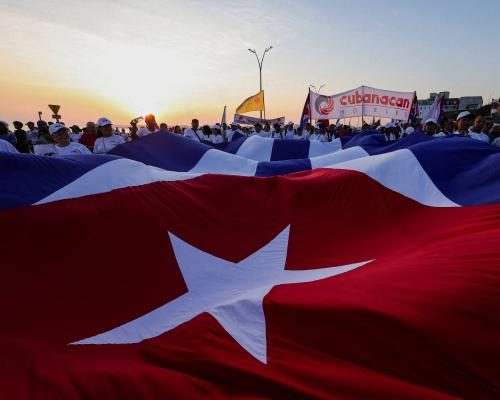
Cuba's government has condemned the latest sanctions imposed by former President Donald Trump, labeling them as "collective punishment" against its people. This assertion came amid significant celebrations for International Workers' Day on May 1, with thousands gathering outside the U.S. embassy in Havana to express their determination to defend the nation. The executive order, announced by Trump on Friday, targets individuals involved in various sectors of the Cuban economy in a bid to increase pressure on the island following the ouster of Venezuela's Nicolás Maduro earlier this year.
Foreign Minister Bruno Rodriguez took to social media platform X (formerly Twitter) to voice the government's strong opposition, stating, "We firmly reject the recent unilateral coercive measures adopted by the #UnitedStates government." He emphasized that these sanctions unjustly punish the Cuban populace rather than addressing any specific wrongdoing by the government. The sanctions come as part of a broader strategy by Trump, who has made remarks indicating a desire for more aggressive U.S. action towards Cuba, including the possibility of military interventions. Originally reported by The Guardian.
Trump's Sanctions Target Broad Economic Sectors
The sanctions, which were outlined in an executive order, focus on individuals and entities operating in key areas of the Cuban economy, including energy, defense, and financial services. By doing so, Trump aims to tighten the economic vise on Havana. The measures specifically target those involved in sectors crucial to Cuba's economy, as well as officials accused of serious human rights violations and corruption.
Jeremy Paner, a former investigator at the U.S. Treasury's Office of Foreign Assets Control, noted that this move represents the most significant shift for non-American companies since the inception of the U.S. embargo against Cuba. "Oil and gas, mining companies, and banks that have carefully segregated their Cuba operations from the United States are no longer protected," he explained. This change could have lasting ramifications for international businesses seeking to navigate the complex landscape of U.S.-Cuban relations.
Worsening Economic Conditions in Cuba
The economic situation in Cuba has deteriorated notably since the U.S. imposed a fuel blockade in January, resulting in severe supply shortages and frequent power cuts. The tourism sector, which was once a lifeline for the island's economy, has also suffered dramatically, further exacerbating the hardships faced by ordinary Cubans. Only one Russian oil tanker has successfully reached Cuba since the blockade began, highlighting the crippling effects of the sanctions.
During the May Day celebrations, Cuban President Miguel Diaz-Canel led the march towards the U.S. embassy, reinforcing the message of resistance against what he termed the "genocidal blockade" and the imperial threats posed by the U.S. The slogans shouted by the demonstrators underscored their commitment to defending their homeland against external pressures. The stark realities of daily life for many Cubans stand in contrast to the ideological fervor displayed during these public demonstrations.
U.S.-Cuba Relations: A Rocky Path Forward
Despite the recent escalation in tensions, there were indications that the U.S. and Cuba were on a tentative path toward dialogue. Senior U.S. officials had visited the island for discussions in April, raising hopes for a potential thaw in relations. Historically, the U.S. has demanded that Cuba reform its state-run economy, compensate for properties expropriated during Fidel Castro's regime, and conduct free elections.
However, Cuba remains steadfast in its position that its socialist government is not open for negotiation. The recent sanctions, which coincide with a significant national holiday, reflect a complex and often adversarial relationship that has persisted for decades. As both nations navigate these turbulent waters, the impact of the U.S. sanctions will undoubtedly continue to resonate throughout Cuban society.
As the situation unfolds, the Cuban government is likely to maintain its stance against what it perceives as unjust foreign intervention. The resilience displayed by Cubans during the May Day protests indicates a continued commitment to their sovereignty, even in the face of mounting economic challenges. The international community will be watching closely as these developments play out, particularly the implications for U.S.-Cuban relations moving forward.
Originally reported by The Guardian. View original.