
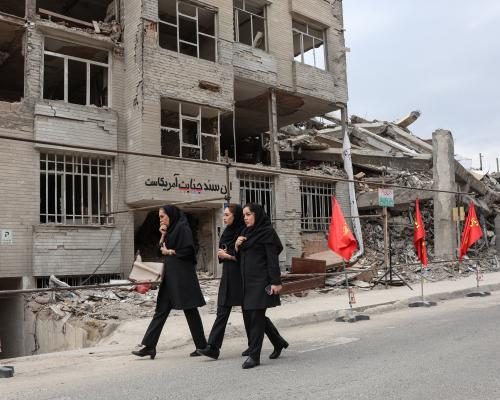
As a fragile ceasefire holds, residents of Tehran are cautiously returning to a city scarred by war. Many face the daunting task of navigating bombed-out buildings and a crumbling economy. With fears mounting over the ceasefire's stability, daily life remains uncertain for those who have returned.
Tehran's Streets: A Landscape of Destruction
Mehdi, a 36-year-old IT professional, fled Tehran early in the conflict, seeking refuge with family in northern Iran. Upon his return, he was met with a haunting scene: bombed-out buildings, shattered glass, and rubble littering the streets. His own home was not spared-the bedroom windows blown out, and debris scattered Throughout. "There's a whistling sound I hope you never hear.. a missile so close that you don't know if it's going to hit your house or your neighbour's," he said, recalling the harrowing days just before the ceasefire was declared. In a matter of seconds, three missiles struck his street. Originally reported by The Guardian.
Now, as he and thousands of other residents filter back into the city during this tenuous truce, they navigate a landscape of destruction. "Our home is now barely livable. In some sense, we've become war refugees," Mehdi lamented, as he and his wife have resorted to sleeping in their living room, the least damaged area of their home.
The Economy in Crisis
The toll on civilian infrastructure has been catastrophic. Noor, an activist who remained in Tehran during the conflict, reported widespread devastation: "Explosions have destroyed schools, universities, pharmaceutical production centres, hospitals.. civilian homes, private cars and city buses." As residents attempt to return to normalcy, many are grappling with the fallout of an economy in freefall.
The ongoing internet blackout, now exceeding 45 days, has further complicated matters. Noor explained that many people who relied on online work have lost their livelihoods. "Internet shutdowns have destroyed online jobs," she said, adding that about 10 million Iranians depend on internet access for income. The affordability crisis, already severe before the war, has now escalated. "Almost all food items have become more expensive. Most people can no longer afford red meat and fish. Dairy products have increased in price by more than 40%," she stated.
As Tehran's streets fill with returning residents, basic grocery items are becoming increasingly difficult to afford. Factories are struggling to operate due to a lack of raw materials, and many workers have been laid off or faced reduced hours. International businesses and banks are under immense pressure, and the instability continues to disrupt everyday life.
Life Under Surveillance
Arash, a 21-year-old student who also fled the city, said the atmosphere in Tehran is charged with tension. Upon his return, he found a city heavily surveilled by security forces, including police and the Islamic Revolutionary Guard Corps (IRGC). "They search vehicles and phones. One day, I saw all three [sets of security forces] in a single street and crossed all the three checkpoints," he recounted. The presence of heavily armed guards is a constant reminder of the precarious situation.
Reports have emerged of children being recruited for security duties, raising serious ethical concerns. "Some of them are kids [who look as if they are aged about] 10 or 12, and are armed," Arash said, expressing his dismay at the sight of children caught in this turmoil. The IRGC has reportedly set a minimum recruitment age of 12, leading to fears about the exploitation of young people in conflict.
The Uncertain Path Ahead
As Tehran residents navigate the aftermath of war, many are left with a lingering sense of anxiety and uncertainty. The prospect of renewed conflict looms large as the ceasefire's future remains unclear. The ongoing economic crisis, coupled with the destruction of infrastructure, poses significant challenges for everyday life.
Despite the fragile calm, Mehdi, Noor, and Arash all share a common sentiment: the fear that peace is temporary. They strive to reclaim a semblance of normalcy amidst the ruins, while grappling with the daunting realities of a city that feels like a ticking time bomb. With the ceasefire in a precarious balance, the people of Tehran are left waiting, hoping that their city can emerge from the shadows of war.
Originally reported by The Guardian. View original.