
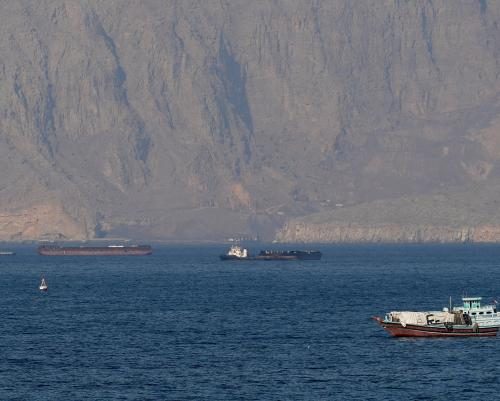
A tanker was reportedly struck by unknown projectiles in the Strait of Hormuz, shortly after former President Donald Trump announced a U.S. initiative to assist vessels trapped in the waterway. The incident occurred 78 nautical miles north of Fujairah, United Arab Emirates, raising concerns over maritime security in a region critical to global oil supply.
U.S. Maritime Assistance Amid Rising Tensions
In a statement made on Sunday, Trump declared that the U.S. would begin a humanitarian operation aimed at aiding neutral countries whose ships have become stranded in the Strait of Hormuz. He referred to these vessels as "locked up" due to Iranian actions that have restricted access to this vital shipping route. "We have told these countries that we will guide their ships safely out of these restricted waterways, so that they can freely and ably get on with their business," Trump wrote on his Truth Social account. Originally reported by The Guardian.
The U.S. Central Command announced plans to deploy significant military resources, including guided-missile destroyers, over 100 aircraft, and 15,000 service members, to support the initiative. However, subsequent reports suggested that the U.S. Navy might not necessarily escort ships through the strait, leaving some uncertainty about the operation's logistics and effectiveness.
Incident Details and Safety Measures
The United Kingdom Maritime Trade Operations agency confirmed that the tanker hit by projectiles had all crew members safe following the attack. The agency is currently investigating the incident while advising vessels to "transit with caution" in the area. This warning underscores the heightened risks that commercial shipping faces in the Strait of Hormuz, a narrow passage where approximately one-fifth of the world's oil supply is transported.
The attack comes against a backdrop of escalating tensions between the U.S. and Iran, particularly as Iran has been accused of blocking nearly all shipping from the Gulf, with the exception of its own, for over two months. The U.S. had previously imposed its own blockade on ships originating from Iranian ports, further complicating the maritime landscape.
Iranian Response and Diplomatic Implications
On the diplomatic front, Iran announced that it had received a response from the U.S. regarding its latest offer for peace talks. This communication occurred shortly after Trump indicated he might reject Iran's proposal, citing that "they have not paid a big enough price." Iranian state media reported that the U.S. conveyed its response via Pakistan, and Tehran is now reviewing the contents of this reply.
Iran's foreign ministry spokesperson, Esmaeil Baghaei, indicated that there are currently no nuclear negotiations underway, referring specifically to the Iranian proposal to postpone discussions on nuclear issues until after the ongoing conflict has been resolved and both sides agree to lift blockades affecting Gulf shipping.
Escalation in Regional Conflicts
The situation remains volatile as Israel has also intensified its military actions, ordering the evacuation of thousands of residents from 11 towns and villages in southern Lebanon. This escalation is part of the ongoing conflict between Israel and Hezbollah, Iran's ally, which has been unfolding alongside the broader U.S.-Iran tensions. The potential for further military engagements raises concerns about the impact on regional stability and international maritime operations.
As the U.S. prepares to execute its maritime assistance plan, the prospect of an armed response to any interference looms large. Trump warned that any obstruction to the U.S. operation would "have to be dealt with forcefully," signaling a possible escalation in military engagement should the situation deteriorate further.
The developments in the Strait of Hormuz highlight the precarious balance in a region marked by longstanding geopolitical rivalries. With the U.S. taking a more proactive role in ensuring the safety of maritime operations, the international community will be closely monitoring the unfolding situation as diplomatic efforts to stabilize the area continue.
Originally reported by The Guardian. View original.