
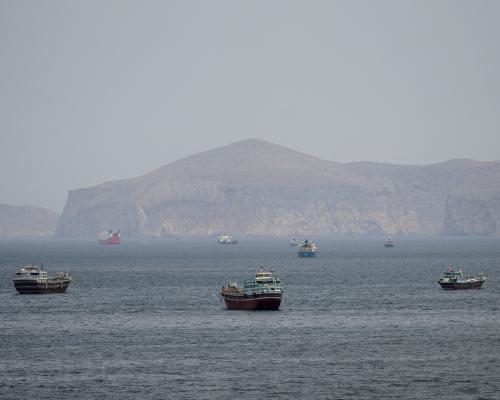
The Strait of Hormuz is witnessing an escalation in tensions as the United States and Iran engage in a contentious struggle over maritime blockades. Following President Donald Trump's recent decision to indefinitely suspend military action against Iran, including plans to bomb key infrastructure, the confrontation has shifted from land to sea. Both nations are now testing their capabilities to enforce their respective blockades in this critical global waterway.
Shifting Strategies: From Land to Sea
Trump's decision, made late Tuesday, has been interpreted by many as a stalling tactic, but diplomatic channels remain open, particularly through Pakistan, which continues to express optimism about potential negotiations in Islamabad. Nevertheless, the conflict has now transitioned to the waters of the Strait of Hormuz, where military maneuvers are intensifying. Originally reported by The Guardian.
Iran has adopted aggressive tactics, including firing upon and seizing commercial vessels that attempt to navigate the strait, aiming to demonstrate its continued influence over this vital shipping route. Conversely, the United States is enforcing a blockade of Iranian ports, striving to cripple the Iranian economy by limiting its ability to export oil.
This maritime standoff represents a new form of gunboat diplomacy, with both nations attempting to assert their dominance. A senior Iranian official, Gholamhossein Mohseni-Eje'i, emphasized, "The enemy is not in a position to set a timeline for us." Meanwhile, U.S. Treasury Secretary Scott Bessent warned that Iran's oil storage facilities are nearing capacity, predicting dire consequences for Tehran if production must be halted.
Economic Warfare: Blockades and Sanctions
The stakes are high, with Iran facing the possibility of a significant economic downturn. The United States aims to drive Iranian oil storage levels to critical limits, which could lead to a shutdown of oil production. Bessent pointed out that "Kharg Island storage will be full and the fragile Iranian oil wells will be shut in," indicating that constraining Iran's maritime trade is a direct assault on its main sources of revenue.
Analysts from the Foundation for Defense of Democracies have suggested that the strait is a liability for Iran rather than an asset. They argue that a lack of storage could lead to irreversible damage in oil reservoirs, potentially costing Iran between $9 billion to $15 billion due to forced shutdowns of production. This assessment is echoed by retired naval officer Lance B. Gordon, who warned that prolonged inactivity could have long-term consequences for Iran's oil output.
Iran's Response: Navigating the Blockade
Despite U.S. efforts, Iran has reportedly found ways to circumvent the blockade. The cargo tracking firm Vortexa indicated that at least 34 tankers linked to Iran have successfully navigated the U.S. blockade since its inception, with 19 vessels leaving the Persian Gulf and 15 entering from the Arabian Sea. These tankers have transported approximately 10.7 million barrels of Iranian crude oil, generating an estimated $910 million in revenue.
Iran also points to the resilience of its economy, citing the ongoing high price of oil, which remains above $100 a barrel. This price level, despite U.S. sanctions, has had ripple effects across global markets, contributing to various economic disruptions, including the cancellation of 20,000 Lufthansa flights due to soaring jet fuel costs and hotel vacancies in Europe.
Strategic Implications and Future Considerations
As tensions mount, Iran's Revolutionary Guards have issued stern warnings to neighboring countries. Majid Mousavi, commander of the aerospace force of the Revolutionary Guards, stated, "Iran's southern neighbours should know that if their geographies and facilities are used in the service of enemies to attack the Iranian nation, they must say goodbye to oil production in the Middle East." This rhetoric underscores Iran's resolve to protect its interests amid external pressures.
Moreover, Iran hints at alternative strategies, including potential disruptions to internet cables that are crucial for regional communication networks. Such actions could have severe implications for the digital economies of Gulf nations, but escalating tensions could also lead to internal strife within Iran, already burdened by economic hardship.
While Trump claims to observe signs of disunity within Iran's leadership, the situation remains complex. The pressure on ordinary citizens continues to grow, exacerbated by ongoing internet blackouts and economic challenges. As this geopolitical saga unfolds, all eyes remain fixed on the Strait of Hormuz, a vital artery for global trade and energy supplies.
Originally reported by The Guardian. View original.