
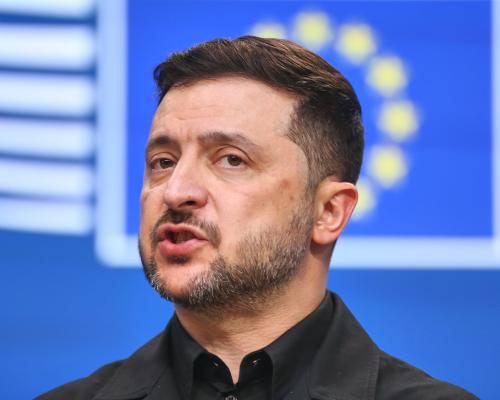
In a significant move, European Union leaders are poised to finalize a €90 billion loan for Ukraine, coupled with a new round of sanctions against Russia. This decision follows months of delays primarily attributed to Hungary's Prime Minister Viktor Orbán, who has now indicated that he will no longer obstruct these initiatives. As the EU convenes in Cyprus, the urgent discussions on Ukraine's financial aid and pressure on Russia take center stage, underscoring the bloc's commitment to supporting Ukraine amidst ongoing conflict.
Zelenskyy Addresses 'Donnyland' Controversy
Meanwhile, Ukrainian President Volodymyr Zelenskyy has dismissed a report from the New York Times suggesting that Ukraine considered renaming its Donbas region to "Donnyland" in honor of former U.S. President Donald Trump. The report indicated that the idea, initially floated as a joke, was later proposed during negotiations as a way to curry favor with Trump and push for a more aggressive stance against Russia. When questioned by the Guardian, Zelenskyy firmly stated that the term "Donnyland" was never discussed in negotiations. He emphasized, "During my negotiations, no terms other than 'Donetsk Oblast', 'Luhansk Oblast', 'our Donbas' or 'territory of Ukraine' were used." Originally reported by The Guardian.
Zelenskyy underscored the importance of maintaining Ukrainian sovereignty over the Donbas regions, asserting, "The main thing is that the Donetsk region and the Luhansk region remain Ukrainian territory, as they are, so that there is no 'Putinland'." His remarks come amid ongoing pressure from the White House for Ukraine to relinquish control over parts of the Donbas as part of a potential peace agreement. The Kremlin has claimed that Trump agreed to such a handover during a summit with Russian President Vladimir Putin, a claim Zelenskyy categorically denies, citing constitutional restrictions on ceding territory.
EU Leaders Rally for Ukraine Support
As EU leaders prepare for their summit in Cyprus, the focus will not only be on Ukraine's financial stability but also on the ongoing crisis in the Middle East. The €90 billion loan package, which has faced significant obstacles, is now set to move forward after Hungary and Slovakia indicated their willingness to unblock it. Slovakia's Economy Minister Denisa Saková confirmed that Russian oil deliveries through the Druzhba pipeline have resumed overnight, a condition that Hungary had set for lifting its objections.
Zelenskyy is anticipated to join the EU leaders in Cyprus, marking a pivotal moment in the EU's support for Ukraine. The loan is seen as crucial for bolstering Ukraine's economy, which has been severely impacted by the ongoing conflict with Russia. The EU's commitment to provide substantial financial aid reflects a significant shift in the bloc's approach, highlighting a united front against Russian aggression.
Orbán's Exit from EU Leadership
In a notable development, Viktor Orbán will not attend the upcoming summit in Cyprus, marking what could be his last appearance as the longest-serving member of the European Council, a title that will soon pass to Poland's Donald Tusk. Orbán's absence underscores the shifting dynamics within the EU, particularly concerning Hungary's stance on Ukraine and its alignment with broader European policies.
With Hungary's concessions on the loan and sanctions, the EU appears ready to solidify its stance against Russia while reinforcing its support for Ukraine. The timely unblocking of the loan and sanctions package demonstrates the bloc's adaptability and commitment to addressing the challenges posed by the ongoing conflict. As discussions unfold, the implications for both Ukraine and EU-Russia relations will be significant.
As the situation evolves, all eyes will be on the outcomes of the Cyprus summit and the potential ramifications for future EU strategies regarding Ukraine and sanctions against Russia. With Zelenskyy's participation, the EU aims to send a strong message of solidarity, illustrating the bloc's readiness to stand firm against external pressures and support a nation in crisis.
Originally reported by The Guardian. View original.