
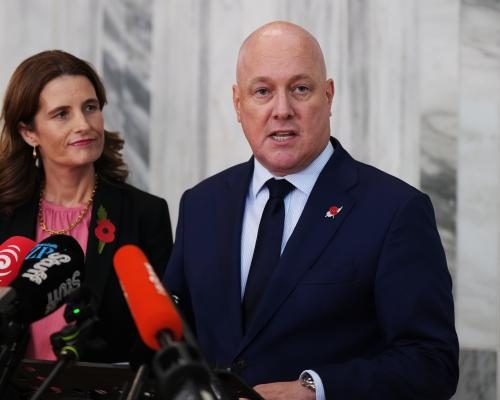
New Zealand Prime Minister Christopher Luxon is facing mounting pressure as his party trails in the polls, prompting concerns about his leadership on the eve of the general election. Following a tumultuous National caucus meeting, Luxon publicly scolded the media for their coverage of his leadership, stating he would no longer engage with questions regarding his position. This decision comes at a critical time when his party is struggling to maintain voter support against the opposition Labour Party.
Polling Woes and Confidence Votes
For the past year, the National Party, led by Luxon, has experienced a significant decline in polling numbers. As of January 2026, the party was trailing the Labour Party by a mere 0.67% on average. However, by April 2026, that gap had widened to an alarming 5.86%, raising fears that National could become the first one-term government since its inception in 1936. This scenario is particularly troubling for party leadership, given that National has historically maintained a stronghold over New Zealand politics. Originally reported by The Guardian.
Leader popularity plays a crucial role in voter behavior, and Luxon's approval ratings reflect a troubling trend. His net approval rating plummeted from +11 in February 2024 to approximately -19 in March 2026, placing him in a precarious position ahead of the elections. The media scrutiny surrounding Luxon's leadership has intensified, with speculation swirling about whether he should lead the National Party into the upcoming general election scheduled for November 7.
Luxon's Reaction to Media Scrutiny
In an unexpected move, Luxon chose to confront the media directly after a National caucus meeting, where he successfully passed a formal motion of confidence in his leadership. Emerging after two and a half hours of discussions, he delivered a brief, prepared statement declaring the matter "now closed." Luxon criticized the media's focus on speculation, stating, "If you want to keep focusing on speculation and rumour, I'm not going to engage." He further dismissed the media's interest as a "soap opera," effectively shutting down further questions before walking away.
This reaction marked a significant departure from the norms of political engagement in New Zealand, where leaders are expected to be accessible and responsive to media inquiries. In chastising the press, Luxon violated a fundamental principle of political leadership: do not shoot the messenger. The media's inquiries were not mere gossip but rather a reflection of public sentiment regarding his leadership capabilities.
Potential Fallout from Leadership Crisis
The fallout from Luxon's media confrontation was swift. Winston Peters, leader of the coalition partner New Zealand First, expressed that it would have been prudent for Luxon to inform him in advance about the confidence motion. In response, National's deputy leader, Nicola Willis, and Luxon countered that a vote for New Zealand First would essentially be a vote for Labour, highlighting the tense dynamics within the coalition. The urgency to consolidate their voter base is palpable, particularly as National faces competition from New Zealand First, which has recently been gaining traction.
Experts suggest that Luxon's leadership style may be more suited to a corporate environment than the complexities of political governance. As a CEO, he might answer to a board, but as Prime Minister, he must answer to the entire electorate. A lack of engagement with the media and voters could have severe repercussions, especially if his approval ratings continue to sink. Political analysts argue that a CEO with a staff engagement score below 20% would face severe inquiries from their board - a parallel that raises questions about Luxon's fitness for office.
Looking Ahead: The Road to Election Day
While Luxon survived the confidence vote within his caucus, this internal affirmation does not equate to regaining the trust of the electorate. His leadership remains under scrutiny, and the clock is ticking as the general election approaches. Luxon's recent actions suggest he may still be grappling with the demands of his role as Prime Minister, where accountability extends far beyond party lines.
As the National Party prepares for the November election, Luxon must navigate the complexities of coalition politics while addressing the growing concerns among voters. The stakes are high, and failure to connect with the public could lead to significant losses. With the general election looming, the question remains: can Luxon turn his leadership around, or will New Zealand witness a historic shift in political power?
Originally reported by The Guardian. View original.