
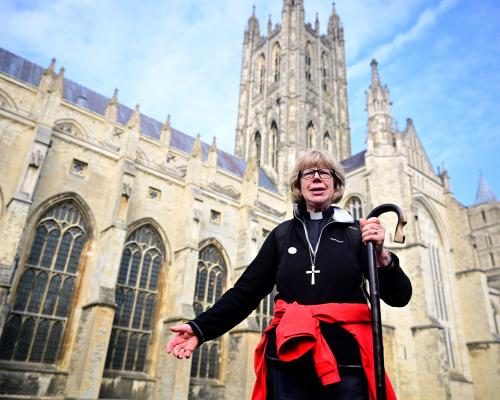
In a historic ceremony today, Sarah Mullally is set to be installed as the 106th archbishop of Canterbury, making her the first woman to assume this pivotal role in the nearly 1,500-year history of the Church of England. Taking on the leadership of the Anglican communion, Mullally steps into her new position at a particularly challenging time for the church, which is beset by safeguarding failures, internal conflicts, and debates regarding its relevance in contemporary British society.
Challenges Awaiting the New Archbishop
As Mullally takes on this critical role, she inherits a legacy fraught with complexities. Her predecessor, Justin Welby, left under a cloud of scrutiny following a significant report that criticized him for mishandling abuse allegations related to John Smyth, a prolific abuser whose actions have left a dark mark on the church. The report highlighted serious failures in safeguarding practices, and Welby was publicly ashamed of his comments made during a speech in the House of Lords, where he appeared to trivialize these grave issues. About 130 boys are believed to have been victimized by Smyth, a former chair of a conservative charity. Originally reported by The Guardian.
Mullally, who previously served as the Bishop of London, has openly discussed the misogyny she has faced in her career, stating, "It is fair to say that I have, both in my secular role as well as in the church, experienced misogyny at times." This context adds an additional layer of both support and resistance to her new role. Harriet Sherwood, a veteran journalist, notes that although many welcome the appointment of a woman into this influential position, not everyone shares that sentiment.
Safeguarding as a Priority
One of Mullally's foremost priorities will be addressing the church's safeguarding issues. She has emphasized that safeguarding is a "fundamental, non-negotiable responsibility," and asserts that victims and survivors must be at the "heart of all we do." With her background as a former chief nursing officer for England, Mullally is perceived as well-equipped to engage with survivors and advocate for meaningful reform.
Despite her previous experience, Mullally has faced scrutiny herself regarding her handling of abuse cases while leading the Diocese of London. However, a complaint against her was dismissed by Archbishop of York Stephen Cottrell, who found no misconduct on her part. Many observers, including Sherwood, express confidence in Mullally's ability to lead effectively during this tumultuous time, noting, "The fact she is a woman makes a difference in terms of engagement with survivors." Nevertheless, the church's decision in 2025 to reject a fully independent safeguarding model still looms large.
A Divided Church and Global Challenges
The Church of England is not only grappling with safeguarding issues but also facing significant divisions within the global Anglican community. There are factions that do not recognize women priests, which complicates Mullally's leadership role. This existing division has been exacerbated by the church's failure to reach consensus on LGBTQ+ reforms. Recently, the General Synod halted discussions on allowing services to bless same-sex civil marriages, leaving the church's stance on sexuality and gender as contentious as ever.
Harriet Sherwood points out that the Anglican church has long been split on these issues, and the current landscape remains fraught with tension. Mullally's leadership will be tested as she attempts to unify a diverse and often polarized congregation. The challenges she faces are manifold, and her ability to navigate these complexities will be crucial in determining the church's future.
Looking Ahead: The Path Forward for Mullally
As Mullally embarks on her new role, her response to these multifaceted challenges will be closely watched. Her experience, both in the secular world as a former NHS worker and within the church, positions her uniquely to facilitate dialogue and inspire change. Many hope that she can guide the church toward a more inclusive and compassionate future. This moment marks a significant shift in the church's history, as it seeks to reconcile its past with the demands of a modern society.
In her new position, Mullally's actions will resonate beyond the church, influencing discussions on gender equality and safeguarding in broader British public life. As the first female archbishop of Canterbury, her leadership may very well redefine the role and impact of the Church of England in the 21st century.
Originally reported by The Guardian. View original.