
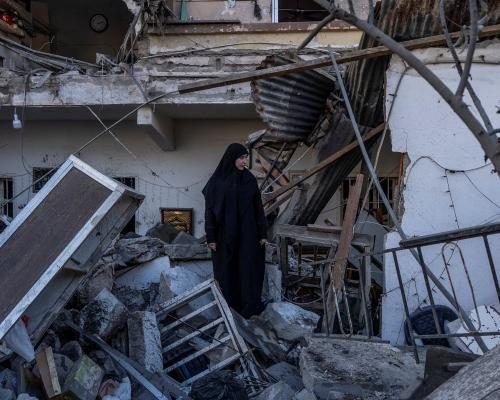
The Ongoing Conflict in the Middle East has intensified as Iran launched a series of strikes on US military bases in the Gulf region. This aggressive move comes as the Trump administration attempts to broker a ceasefire through a 15-point peace plan delivered to Iran via Pakistan. In response, Iranian officials have ridiculed the US's efforts, calling them futile.
Iran's Bold Response to US Ceasefire Efforts
On Wednesday, Lt. Col. Ebrahim Zolfaghari, a spokesperson for the Iranian military, publicly mocked US attempts at negotiating a ceasefire, asserting that the United States is merely negotiating with itself. In a video broadcast on state television, Zolfaghari declared that the US's so-called "strategic power" had devolved into what he called a "strategic failure." He added, "The one claiming to be a global superpower would have already gotten out of this mess if it could. Don't dress up your defeat as an agreement. Your era of empty promises has come to an end." Originally reported by The Guardian.
Zolfaghari's comments follow the Trump administration's dispatch of a ceasefire proposal intended to halt the ongoing violence. He further stated, "Our first and last word has been the same from day one, and it will stay that way: Someone like us will never come to terms with someone like you. Not now, not ever." This defiant rhetoric underscores Iran's unwillingness to engage in negotiations perceived as unfavorable.
Market Reactions to Diplomatic Developments
In the wake of these developments, financial markets reacted swiftly. Oil prices dropped significantly, with Brent crude falling by 5.92% to $98.30 per barrel, while West Texas Intermediate saw a decline of 5.01%, trading at $87.72. The optimism in Asian markets, fueled by reports of Trump's peace plan, saw Japan's Nikkei 225 rise by 2.8%, South Korea's Kospi increase by 3.1%, and the Hang Seng index in Hong Kong gain 1.2%.
However, uncertainty looms over the effectiveness of the ceasefire plan, as sources suggest it remains unclear how broadly it has been shared among Iranian officials or whether they would consider it a viable basis for negotiations. This ambiguity has cast a shadow over the potential for peace, as many analysts remain skeptical about the likelihood of a resolution.
Impact of Conflict on Global Food Supplies
The ongoing conflict has far-reaching implications beyond military engagements, particularly concerning global food supplies. Jean-Marie Paugam, deputy director-general of the World Trade Organization, warned that disruptions in the Strait of Hormuz-where a third of the world's fertilizers typically transit-could lead to food scarcity and elevated prices. The strait has been effectively closed by Iran since the outbreak of hostilities, impacting the flow of essential agricultural products.
Paugam cautioned that while there is currently no fertilizer shortage, the sustained conflict could lead to significant supply challenges for major food-exporting nations. "The effect compounds the following year: harvests shrink and prices rise," he noted. Countries reliant on urea, a nitrogen-based fertilizer, such as India, Thailand, and Brazil, could face severe consequences as planting seasons approach.
Furthermore, nations that import most of their food, particularly in West and North Africa, are particularly vulnerable. Paugam emphasized that if countries begin stockpiling-similar to actions taken during the COVID-19 pandemic-the situation could worsen substantially.
US Military Deployment Amid Rising Tensions
Against this backdrop, the United States is preparing to bolster its military presence in the Middle East. Reports indicate that at least 1,000 troops from the 82nd Airborne Division will be deployed in the coming days, a move reportedly approved by President Trump. This elite infantry division specializes in rapid deployment and forcible entry operations, underscoring the seriousness with which the US is treating the escalating conflict.
As tensions rise, Iran's Revolutionary Guards have indicated that they have intensified their military actions, targeting locations in Israel, including Tel Aviv and Kiryat Shmona, as well as US bases in Kuwait, Jordan, and Bahrain. Concurrently, Israeli airstrikes in Lebanon have resulted in civilian casualties, further complicating the humanitarian situation in the region. According to Lebanese authorities, at least 1,072 people have died, with more than one million displaced since the conflict began.
As the situation evolves, analysts will closely monitor both military actions and diplomatic efforts in hopes of resolving this ongoing crisis.
Originally reported by The Guardian. View original.