
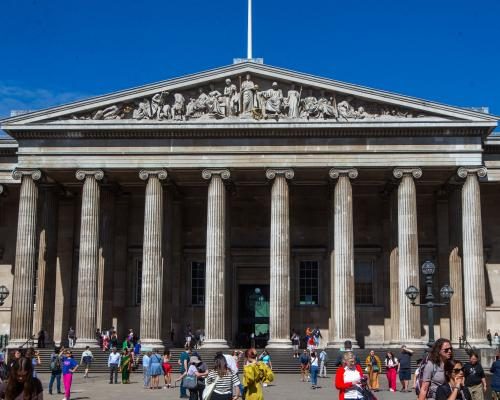
The Palestinian ambassador to the United Kingdom, Husam Zomlot, has formally requested the intervention of the Foreign Office following the British Museum's controversial decision to remove references to Palestine from its displays. This act has drawn significant attention, particularly in light of the UK's recognition of Palestine as a state in September 2025. Yet, shortly thereafter, the British Museum altered its exhibits, replacing the term "Palestine" with references to Gaza and the West Bank on a panel outlining present-day countries within the ancient Levant.
Zomlot has characterized this action as a historical "erasure," occurring amidst a broader context of conflict and destruction faced by Palestinians. He pointed out that several human rights organizations and a report from a United Nations independent commission have described the situation as akin to genocide. Israel's actions, including the removal of archaeological relics from occupied territories and the bombing of a major storage facility for ancient artifacts in Gaza City, further exacerbate these concerns. Originally reported by The Guardian.
Demands for Restoration of Historical References
In his ongoing efforts, Zomlot has demanded the restoration of the term "Palestine" and its derivatives on various explanatory panels throughout the museum, particularly within the ancient Levant and Egyptian rooms. During a meeting with Nicholas Cullinan, the museum's director, and several curators on March 24, Zomlot expressed his disappointment when no commitment was made to reverse the changes. Instead, he was offered a tour of the museum, which he declined, stating that without corrective action, further engagement would not be appropriate.
"In the absence of corrective action, or a clear commitment to address the issues identified, it would not have been appropriate to engage further in a manner that could be interpreted as an endorsement of the current presentation," Zomlot stated in a letter to Cullinan dated April 9, which has been seen by the Guardian and New Lines Magazine. He reiterated his willingness to discuss the matter further but emphasized that he would only accept a tour after the necessary corrections were made.
British Museum's Position and Response
In its defense, the British Museum issued a statement asserting that it has not removed the term "Palestine" from its displays and continues to reference it throughout various galleries, both contemporary and historical, as well as on its website. However, this statement appears to conflict with photographic evidence showcasing the changes made and previous remarks that suggested a broader removal of the term.
While the name "Palestine" is still present in some contexts-such as maps of the ancient Middle East in the Egypt room-Zomlot's concerns have escalated since the changes became public knowledge. Reports indicate that the alterations were initiated following concerns raised by UK Lawyers for Israel (UKLFI), a pressure group that argued the museum's previous references to Palestine risked obscuring the history of Israel and the Jewish people. The museum reportedly did not respond to UKLFI's letter until after the Telegraph reported on the matter.
Historical Context and Scholarly Skepticism
As the debate continues, scholars of the ancient world have expressed skepticism regarding the necessity of the changes made by the museum. The term "Canaan" is frequently mentioned in the Bible, yet it appears in only a limited number of contemporary inscriptions from the late Bronze Age. Historical references to the region often varied, and the name "Peleset," believed to be the root of "Palestine," has been found in Egyptian inscriptions from the 12th century BC, referring to a community in the southern Levant.
Zomlot's assertion that erasing historical references equates to erasing the present highlights the deep sensitivities surrounding the issue. He has reached out to the Foreign, Commonwealth, and Development Office, hoping for government intervention to ensure the museum's exhibits align with the UK government's recognition of Palestine as a state. "For me, this is not only a political issue. This is not only a legal issue. This is not even just a historical issue. This is an existential issue. Because erasing our past is erasing our present," he remarked.
The British government has responded by emphasizing that museums and galleries in the UK operate independently from the government. Consequently, decisions regarding the management of their collections are left to their trustees. Despite the museum's assertive stance, the lack of explanation surrounding the changes remains concerning for advocates of Palestinian history and rights.
Originally reported by The Guardian. View original.