
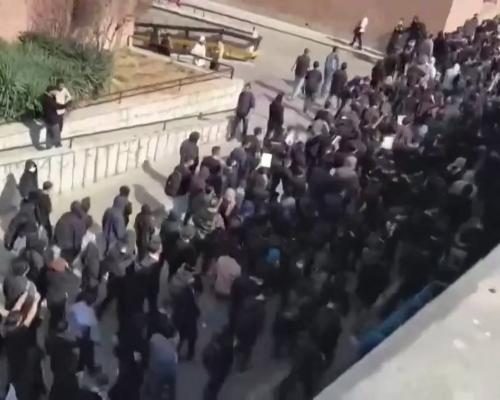
In a powerful resurgence of activism, Iranian students are once again taking to the streets, expressing their grief and outrage more than 45 days after a violent crackdown in January that left thousands dead. As the new academic term commenced on Saturday, students across Tehran and other cities gathered on university campuses, defiantly chanting anti-government slogans despite the heavy presence of security forces and plainclothes officers monitoring their movements.
Among the voices of dissent is 21-year-old Hossein, a student at the University of Tehran, who poignantly remarked, "Our classrooms are empty because the graveyards are full." This sentiment reflects the deep sorrow felt by many students, who are mourning the loss of friends and classmates who were killed during the January protests. Hossein, along with his peers, has chosen to boycott classes as a form of protest against the regime's brutality, emphasizing their commitment to honor those who lost their lives fighting for freedom. Originally reported by The Guardian.
Protests Spread Across Iranian Universities
The protests, now entering their third day, have rapidly expanded beyond Tehran to universities in the northeastern city of Mashhad. Footage shared on social media showcases students chanting slogans against the regime, while clashes with pro-regime Basij forces have erupted in various locations. "They called their spilled blood foreign-backed," Hossein added, referring to the government's narrative that labels dissenters as puppets of foreign powers. "But we know the regime can no longer kill students on campus and call us terrorists."
In Mashhad, students are coordinating their protests with a clear goal: to resist any attempt to return to a sense of normalcy in the aftermath of the January violence. As many as 7,000 people have been confirmed dead according to US-based Human Rights Activists News Agency (HRANA), with an alarming number of additional deaths still under investigation. The organization has also reported over 53,000 arrests amidst the crackdown, including hundreds of students, further fueling the anger and determination of the protesters.
Vigils Transforming into Protests
The atmosphere of grief has driven students to transform quiet vigils into vocal demonstrations. Leyla, a student at Sharif University of Technology, noted that what began as a silent sit-in evolved into a passionate protest, as students felt compelled to speak out against the ongoing repression. "Because nobody can tolerate this much grief," she stated, emphasizing that even if their actions result in no tangible change, they serve a crucial symbolic purpose by demonstrating the regime's inability to silence dissent.
Tensions escalated significantly during the protests, with reports of Basij forces attacking students, threatening them, and even breaking windows at the University of Tehran. Leyla described how confrontations quickly turned physical, with both sides throwing objects at each other. "Many of our students were hurt and bleeding, and many [aligned with] Basij were too," she said, illustrating the volatility of the situation on campuses.
Collective Mourning and Defiance
The collective sorrow felt by students is palpable. Reza, a university student in Mashhad, explained that the grief permeates through society and is particularly felt within university walls. "When society is in mourning, grief and anger are felt at universities too," he remarked. This shared sense of loss and defiance is what motivates students to continue protesting, refusing to return to classes while they mourn their loved ones. "We are all in mourning, and we will confront anything that tries to make the situation appear normal," he asserted, conveying a powerful message of resilience.
Despite the fear that some students feel, the solidarity they experience when gathered together helps to diminish that fear. "We chant: 'Don't be afraid, don't be afraid.. we are all together,'" Reza shared, highlighting a bond strengthened through their collective action. As protests continue to unfold, Hossein anticipates that the demonstrations will persist as long as the pain of their losses remains fresh. "These protests are against the return to normal life while our loved ones' bodies are still warm," he declared, reinforcing the ongoing struggle for justice in Iran.
Originally reported by The Guardian. View original.