
In Manila, transport workers are grappling with severe financial strain as rising oil prices wreak havoc on their livelihoods. Tricycle taxi driver Jayson Naga, who usually earns about P500 (approximately US$8) daily to support his four children, is now feeling the pinch of a staggering 60% surge in fuel prices. "If gas prices go up any further, there will be nothing left for us," Naga lamented, highlighting the daunting reality many face as the Philippines imports nearly all of its crude oil from the Middle East.
Government Declares Energy Emergency
The Philippine government has become the first globally to declare a national energy emergency, a response to the escalating oil crisis driven by ongoing conflicts in the Middle East. This declaration comes as public dissatisfaction grows over the government's handling of soaring fuel prices and supply shortages. Jayson Naga's situation reflects a broader trend, as fellow drivers like Hogan Ruben, also a tricycle operator, now find themselves working longer hours just to make ends meet. "What we do now is we head out early and stay out until twelve midnight or one in the morning, just so the income we bring home is enough," Ruben said, emphasizing the relentless grind they endure. Originally reported by The Guardian.
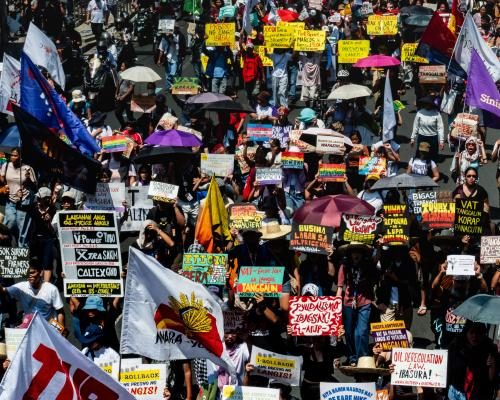
Since President Ferdinand Marcos Jr. acknowledged challenges in securing sufficient oil supplies, he assured citizens that the government had arranged for enough crude oil to last until June 30. Yet, amidst these assurances, frustrations are boiling over. Transport groups have organized nationwide strikes, demanding the repeal of fuel excise taxes and the oil deregulation law. Mody Floranda, president of the transport group Piston, criticized the administration, stating it was "inutile" in addressing the pressing concerns of workers. "Hardship persists not only for transport but for the entire public. How can workers survive on low wages while fuel prices keep climbing?" he asked.
Economic and Human Rights Crisis
This oil crisis transcends mere financial concerns; it poses a significant threat to human rights, according to Edgardo Cabalitan, a worker from a local NGO. He joined a protest outside one of the largest gas stations in the country, where jeepneys and motorcycles honked in solidarity. "The oil crisis is not just an issue of rising costs. It is an issue that directly strikes at human rights. As oil prices rise, the cost of goods follows, affecting not only the livelihoods of drivers but also our very access to basic needs," Cabalitan explained.
Experts predict that the situation will worsen. Jan Carlo Punongbayan, an assistant professor at the University of the Philippines School of Economics, warned that global crude oil prices could soar up to $200 per barrel, leading to double-digit inflation rates by May. This potential inflation spike would mark a significant economic challenge, especially since Filipinos have not experienced such levels for many years, even during the pandemic.
Rising Food Costs and Community Support
As the economic landscape shifts, food prices are expected to rise sharply. Punongbayan noted that while the current harvest season is softening the impact, shoppers are already crowding grocery stores, reminiscent of panic buying seen during the pandemic. Basic necessities are flying off the shelves as families brace for escalating transport costs that will inevitably drive up food prices.
The desperation of the situation has also led to negative incidents. At a gas station in Quezon City, an attendant was left to cover a nearly $100 bill after a driver of an SUV fled without paying for gas. Local police have since launched an investigation into this incident, showcasing the lengths to which some individuals will go amid the crisis.
Yet, amidst these challenges, a spirit of community has emerged. In the Maginhawa neighborhood, food packs have started to appear for struggling drivers like Naga and Ruben. Last Sunday, they received donations that included rice, eggs, noodles, canned goods, and sandwiches, reminiscent of community pantry initiatives from the pandemic. "When we saw that the community pantry was back, it gave us drivers a sense of hope again," Naga reflected, highlighting the resilience and solidarity that continues to shine through even during the darkest times.
As transport workers navigate this tumultuous landscape, their plight serves as a reminder of the broader implications of the oil crisis-not just on economic stability, but on the very fabric of society itself.
Originally reported by The Guardian. View original.