
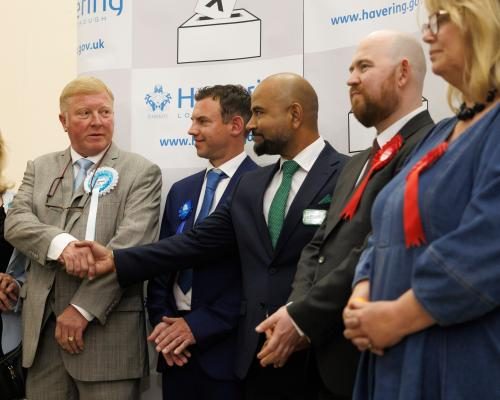
Early results from England's local elections signal a profound shift in the political landscape, with Labour losing over 250 councillors. The rise of Reform UK, which has garnered nearly 400 councillors, reflects a new era of five-party politics, challenging traditional party dynamics and voter behavior.
Labour's Significant Losses Dominate Early Results
The results from England's local elections, announced on Friday morning, indicate that Labour has suffered a substantial loss of more than 250 councillors. This figure is expected to rise as more votes are counted throughout the day. While Labour may attempt to frame these losses as part of the typical difficulties faced by the incumbent Westminster government during mid-term elections, the scale of this setback is particularly alarming. Originally reported by The Guardian.
Reform UK has emerged as the primary beneficiary of the shifting political tides, beginning from a position of no representation in the last local elections. The party has amassed almost 400 councillors, a remarkable feat given its previous absence in these councils. As the day progresses, the final tallies may shift, but the early headlines are unlikely to change. The results from larger areas, including many London councils, are still pending, and with votes for the Scottish Parliament and the Welsh Senedd yet to be counted, the full implications of these elections remain unclear.
Complex Voter Dynamics at Play
Interpreting the results requires caution, as the early losses for Labour do not necessarily indicate a direct transfer of votes to Reform. In several instances, a split vote among left-leaning parties, such as Labour and the Green Party, may have lowered the threshold needed for Reform to win. For example, in Waltham Cross, Labour secured 28.7% of the vote, narrowly holding off Reform, which garnered 28.1%.
This complexity highlights the challenges in drawing straightforward conclusions about voter behavior. It's crucial to recognize that the movement of voters is not always linear; a loss for Labour could stem from multiple factors, including shifting loyalties or splintering support among progressive voters. Consequently, while Labour's losses are stark, they do not provide a clear narrative on how voters are reallocating their support.
Emergence of Five-Party Politics
These Election Results underscore a significant transformation in England's political landscape, evolving from a traditional two-party system into a vibrant five-party system. This shift has been reflected in recent polling data, where the combined support for Labour and the Conservatives has rarely exceeded 40%. Meanwhile, the Green Party has increasingly challenged for the second spot, indicating a fragmentation of voter preferences.
This is the first instance where the impact of this political fragmentation is being witnessed at the ballot box. The implications of a five-party system are profound, particularly under the first-past-the-post electoral system, which complicates coalition-building. Both Labour and the Conservatives now face parties positioned on either side, making it essential for them to develop messages that resonate across a broader electorate. Failure to do so will necessitate coalition-building across party lines, a challenging endeavor set to unfold in councils that have shifted to no overall control.
Looking Ahead to the General Election
The 2024 general election is shaping up to be a significant electoral battle, largely characterized by a deeply unpopular incumbent government struggling to retain support. The Labour Party, while hoping to capitalize on Conservative weaknesses, may find itself in a similar predicament if it cannot effectively navigate the shifting political terrain. The Conservatives, still reeling from losses in local elections, have yet to shake off the perception of being a party out of touch with voters.
As the results continue to roll in, both major parties must grapple with the reality of a fragmented electorate. The emergence of Reform UK and the sustained presence of smaller parties like the Green Party complicates traditional voting patterns, urging larger parties to rethink their strategies. The coming weeks will be pivotal as local councils adjust to this new political reality, laying the groundwork for potential alliances and shifts ahead of the general election.
Originally reported by The Guardian. View original.