
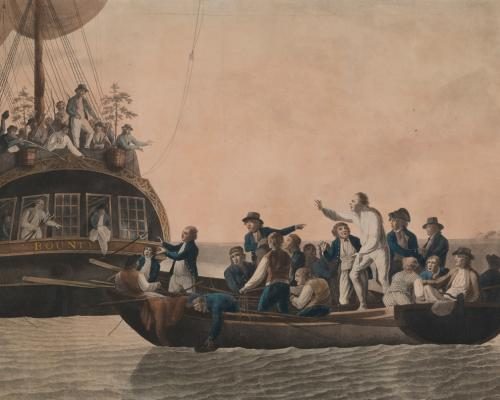
A significant chapter in maritime history is set to unfold as the Pitcairn Register, a handwritten record of the descendants of the infamous Bounty mutineers, makes its way back to the South Pacific. This unique volume chronicles the births, marriages, and deaths of the children and grandchildren of the sailors who seized control of HMS Bounty in 1789 and the Tahitian women they brought to Pitcairn Island. The register will be displayed for the first time on Norfolk Island, where many descendants of these mutineers reside.
A Journey Through History
The Pitcairn Register serves as a vital historical document for the descendants of the Bounty mutineers, who sought refuge on the uninhabited Pitcairn Island in 1790. After the mutiny, nine of the sailors took control of the ship, bringing along 12 Polynesian women, a 10-month-old girl, and six Polynesian men, whom they enslaved. The community, founded on this isolated island, faced numerous challenges, including conflict and murder among its members. Originally reported by The Guardian.
George Hunn Nobbs, a sailor who visited Pitcairn nearly four decades later, observed that the descendants had formed a devout Christian community. He initially documented the births, marriages, and deaths in the register, which later fell into the hands of an acquaintance in England after Nobbs found it damaged in 1854. Ultimately, it was donated to the National Maritime Museum in London.
A Homecoming Celebration
For the first time in over a century, the Pitcairn Register will be showcased on Norfolk Island, an Australian territory in the South Pacific. This event is particularly meaningful for the island's residents, as over 25% of its 2,188 inhabitants can trace their ancestry back to the Bounty mutineers. In preparation for the annual Bounty Day celebrations on June 8, descendants successfully crowdfunded approximately A$26,000 (£13,700) to facilitate the register's return.
Dr. Pauline Reynolds, chair of the Norfolk Island Museum Trust (NIMT) and a descendant of six mutineers, expressed the significance of the register. "It's a foundational document of the Pitcairn and Norfolk Island people," she stated. Her research has highlighted the critical roles played by Polynesian women in maintaining the community through agriculture and medicine, challenging the traditionally male-centric narratives surrounding the mutiny.
Uncovering Untold Stories
The narrative surrounding the Bounty mutineers has often been told from a male perspective, overshadowing the experiences of the Polynesian women and men involved. Dr. Reynolds pointed out that without the contributions of the Indigenous women, many essential survival skills would have been lost. The hardships faced by the community included brutal conflicts, leading to the deaths of several Polynesian men and mutineers by 1794. The register reveals the resilience of the remaining members, with accounts of mothers attempting to protect their children, including failed attempts to escape.
By 1808, when a whaling ship finally encountered the isolated community, only one mutineer remained alive, alongside ten Polynesian women and the first generation of children born on the island. Helen Mears, head of curatorship at the National Maritime Museum, emphasized that the register adds depth to the often one-dimensional portrayal of the mutiny. "The experiences of Polynesian men and women had been erased from a narrative about an iconic historical moment in British maritime history," she noted.
A Collaborative Future
The return of the Pitcairn Register marks not only a significant homecoming but also the beginning of a collaborative effort between the National Maritime Museum and the Norfolk Island community. Mears expressed her hope that this partnership will deepen the understanding of the register's significance for descendants and the broader historical context surrounding the mutiny.
Dr. Reynolds anticipates that the arrival of the register will evoke strong emotions within her community, describing it as "sacred to us. It tells the beginning of our people. It contains who we are." With the register now on display, the descendants of the Bounty mutineers can reconnect with their history, ensuring that the stories of their ancestors and the Polynesian women who played a crucial role in their survival are honored and remembered.
Originally reported by The Guardian. View original.