
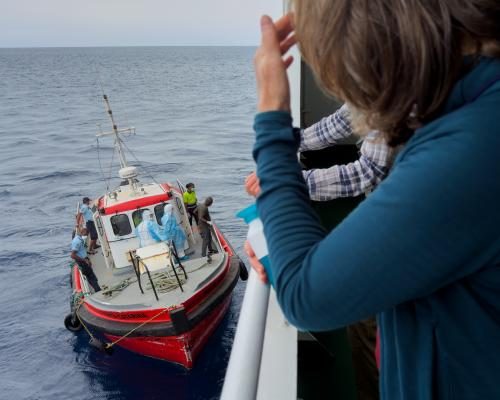
The Centers for Disease Control and Prevention (CDC) has confirmed it will deploy a team to Spain's Canary Islands, where the cruise ship MV Hondius, linked to a hantavirus outbreak, is expected to dock on Sunday. The CDC's response comes as U.S. passengers aboard the ship are set to be evacuated to an airbase in Nebraska. However, public health experts express concerns that the U.S. is ill-equipped to handle such disease threats, questioning the CDC's diminished role in health crises.
Delayed Response Raises Questions
The CDC's response to the hantavirus outbreak has been characterized by delays and a lack of decisive action. The outbreak was first reported to the World Health Organization (WHO) on May 2, with an updated notice two days later indicating seven confirmed or suspected cases. Tragically, three individuals have succumbed to the virus, while one remains critically ill. On Wednesday, the CDC stated it was "closely monitoring the situation," yet most of the response effort has been led by the WHO, raising concerns about the CDC's current capabilities. Originally reported by The Guardian.
It wasn't until Thursday that the CDC activated its 24/7 emergency center in Atlanta to monitor the outbreak, classifying it at the lowest activation level. Late on Friday, the agency issued its first health alert to U.S. doctors, cautioning them about the potential for imported cases after at least six American passengers disembarked at St. Helena. These passengers are now being monitored for hantavirus across several states.
Experts Criticize CDC's Limited Role
Public health experts have voiced significant criticism regarding the CDC's handling of this outbreak. Dr. Jay Bhattacharya, director of the National Institutes of Health (NIH), emphasized that the CDC's experts are coordinating with both domestic and international partners. He stated, "Our CDC team began coordinating with domestic and international partners as soon as we were notified of a hantavirus situation." However, former government health officials have described the response as feeble compared to previous health crises.
Lawrence Gostin, an international public health expert at Georgetown University, remarked, "The CDC is not even a player. I've never seen that before." This sentiment was echoed by Dr. Jeanne Marrazzo, chief executive officer of the Infectious Diseases Society of America, who labeled the outbreak a "sentinel event" that highlights the U.S.'s unpreparedness for disease threats. She stated, "Right now, I'm very sorry to say that we are not prepared." In contrast, Jennifer Nuzzo, director of Brown University's Pandemic Center, downplayed the risk, saying, "I don't think this is a giant threat to the United States," but noted the CDC's current state reflects a lack of leadership.
Monitoring and Health Risks Across States
In the wake of the outbreak, several states-Arizona, Virginia, California, and Georgia-are closely monitoring residents who were on board the MV Hondius. Health officials in Arizona and Georgia reported that those under observation are not exhibiting symptoms, while California's health department confirmed it has no evidence that California residents are ill or infected. Virginia's health department noted that one resident who returned from the cruise is currently healthy and under public health monitoring. They added that the risk to the general public remains low.
Despite these assurances, the lack of clear communication from the CDC has created a vacuum where misinformation can thrive. Former Congresswoman Marjorie Taylor Greene recently shared on social media that she had contacted an alternative medicine practitioner about treatments for hantavirus. The practitioner recommended ivermectin, vitamin D, and zinc, which has sparked further debate about the appropriate response to the outbreak.
Concerns Over CDC's Future Role
The CDC's current response to the hantavirus outbreak has raised significant concerns about its future role in public health crises. The agency has laid off thousands of scientists and public health professionals, including key personnel from its ship sanitation program. This downsizing has led to questions about the agency's capacity to effectively manage health emergencies, especially as the world continues to grapple with various infectious diseases.
This situation serves as a stark reminder of the importance of robust public health infrastructure and the need for clear communication during health crises. As the CDC navigates this outbreak, the effectiveness of its response will be scrutinized, potentially influencing the agency's reputation and authority in future emergencies.
Originally reported by The Guardian. View original.