
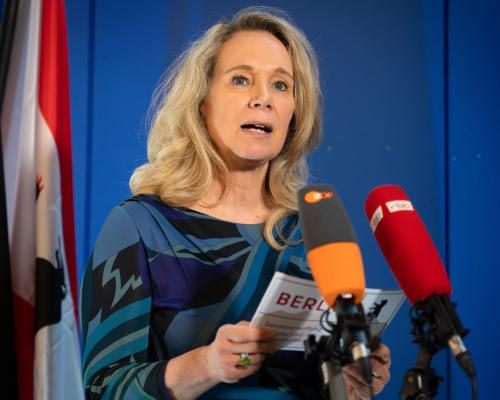
Sarah Wedl-Wilson, Berlin's culture senator, has resigned following a scandal concerning the irregular distribution of €2.6 million in public funds intended to combat antisemitism. The British-born official stepped down after a state audit revealed that funds were allocated unlawfully to 13 projects, prompting political fallout in the German capital.
Irregularities in Funding Distribution Exposed
Wedl-Wilson's resignation comes on the heels of a damning report from the Berlin auditing office, which described the allocation process as "arbitrary" and "clearly unlawful." This report detailed how the €2.6 million earmarked for anti-antisemitism programs was distributed to various projects without proper vetting, raising serious questions about accountability within the culture department. Earlier this week, Wedl-Wilson had already dismissed state secretary Oliver Friederici, who was perceived as a whistleblower within the department. Opposition leaders quickly labeled Friederici's ousting as an attempt to scapegoat him for a deeper systemic issue. Originally reported by The Guardian.
Berlin's Mayor Kai Wegner accepted Wedl-Wilson's resignation, acknowledging her decision to take political and personal responsibility for the scandal. "Sarah Wedl-Wilson has assumed political and personal responsibility - for that she deserves respect," Wegner stated, emphasizing the need for integrity in managing the city's cultural affairs as he prepares for a tough re-election campaign this September.
Political Fallout and Opposition Criticism
The fallout from this scandal has reverberated throughout Berlin's political landscape, with opposition figures expressing deep concern over the implications for the fight against antisemitism. Werner Graf, the Green party's candidate for mayor, criticized the handling of the situation, arguing that it has caused irreparable damage to efforts combatting anti-Jewish sentiment in a city historically associated with the Holocaust. Graf stated, "This has caused immeasurable damage not only to the fight against antisemitism but also to trust in democratic institutions as a whole."
Critics within the opposition have pointed to the political influence of the ruling Christian Democrats (CDU) in the funding decisions, arguing that the distribution of funds was more about political expediency than genuine support for anti-antisemitism initiatives. The inquiry into the funding has raised significant concerns about transparency and oversight in public financing, particularly in areas as sensitive as combating hatred and discrimination.
Controversial Recipients and Their Impact
One of the key recipients of the funds, the Zera Institute, received €390,000 despite its controversial leadership and comments made by its director, Maral Salmassi. Shortly after the institute's founding, Salmassi made headlines for calling Jewish philanthropist George Soros a "parasite" in a social media post, which she later apologized for. Additionally, Salmassi faced backlash for comparing the Guardian newspaper to the Nazi-era publication Der Stürmer, further complicating the narrative surrounding the organization. These controversies have led to increased scrutiny over the appropriateness of funding such entities in the fight against antisemitism.
Moreover, Matthias J Becker, a researcher hired by the Zera Institute, was reported to have falsely claimed affiliations with the University of Cambridge. Although he denied any wrongdoing, the allegations have raised questions about the qualifications of individuals involved in these funded projects. The review by the Berlin auditing office primarily focused on the funding process rather than the actual merits of the projects, leaving many to wonder if the organizations involved will be required to return any of the public financing they received.
Looking Ahead: Rebuilding Trust in Cultural Institutions
As the dust settles following Wedl-Wilson's resignation, the Berlin government faces the daunting task of restoring public trust in its cultural institutions. With an annual budget of €110 million to manage, the next culture senator will have to navigate the complexities of public scrutiny while ensuring that funds are directed transparently and effectively. Wedl-Wilson, who held her position for just five months, expressed gratitude for the opportunity to serve the city, citing her unique position as a political outsider. "As a British woman and an independent, it is by no means a given that I was able to hold and shape this office," she remarked.
The recent surge in antisemitic incidents in Germany, particularly since the outbreak of conflict in Gaza, underscores the urgency of effective measures to combat hate. With mounting political pressures and public expectations, the new leadership in Berlin's cultural sector will need to prioritize integrity and accountability to ensure that the fight against antisemitism remains robust and credible.
Originally reported by The Guardian. View original.