
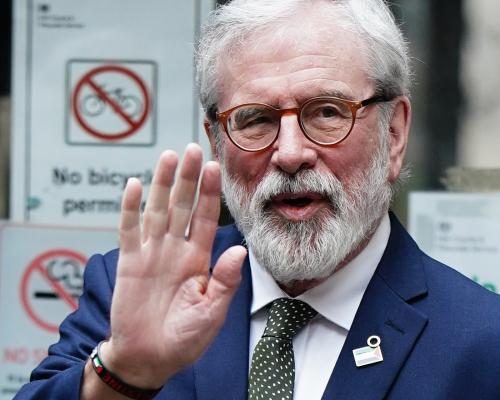
In a high-profile court appearance, Gerry Adams, the former leader of Sinn Féin, emphatically denied any affiliation with the Irish Republican Army (IRA), asserting that the two entities are fundamentally distinct. This assertion was made during a hearing in London, where he is being sued for symbolic damages by three men injured in IRA bombings, which they claim he was complicit in. Adams, now 77, spoke before a courtroom that included victims of IRA violence, making his case against the backdrop of a long and contentious political history.
During his testimony, Adams, who played a key role in the peace process that ultimately ended decades of conflict in Northern Ireland, stated, "To be clear, membership of the political party, Sinn Féin, does not equate to membership of the IRA." He highlighted his party's political objectives, which aim for Irish unity and an end to partition. Adams criticized opponents of Sinn Féin for attempting to conflate the political party with the armed group, underscoring the separateness of their functions. Originally reported by The Guardian.
Legal Proceedings and Claims
The court case involves three claimants: John Clark, Jonathan Ganesh, and Barry Laycock, who are seeking a nominal £1 in damages, a symbolic gesture aimed at vindication rather than financial compensation. They allege that Adams was a member of the IRA and was involved in key operations, including the 1973 Old Bailey bombing and the London Docklands and Manchester bombings in 1996, which resulted in their respective injuries. Their claims rest on asserting that Adams held significant influence within the IRA, including purported membership on its army council.
Adams appeared in the witness box wearing a shamrock and a badge representing the Palestinian flag, further emphasizing his political identity. His testimony was both defensive and assertive, framing the conflict in terms of national identity and resistance. He expressed empathy for the claimants, acknowledging the 'awful experiences' they endured, while firmly denying the allegations against him.
Contentious Cross-Examination
During cross-examination, Sir Max Hill KC, representing the claimants, pressed Adams on his historical connections to the IRA, suggesting he had consistently aligned himself with the organization over many years. Adams responded with a broader analogy, stating, "If your neighbourhood was invaded and occupied some patriotic Englishmen would form themselves in some sort of a resistance movement.." He then clarified that while he supports the peace process, he does not distance himself from the IRA, acknowledging that some actions taken during the Troubles were indefensible.
Hill accused Adams of attempting to "rewrite history" regarding a 1972 delegation that purportedly included IRA representatives in talks with the UK Government. When Hill pointed out that Sean Mac Stíofáin, self-professed chief of staff of the IRA at the time, had cited Adams as a member of the delegation representing the IRA, Adams maintained that the talks were strictly a Sinn Féin initiative.
Adams' Defense and Future Implications
In his written statement, Adams categorically denied all allegations linking him to the bombings, emphasizing that nothing in his defense should be construed as a dismissal of the claimants' traumatic experiences. He reiterated, "Although I deny categorically the allegations made by the claimants of my involvement in those bombings in any way, nothing in this statement should be taken as criticism of the claimants, or as any attempt to deny or diminish their awful experiences." The hearing, which has drawn significant public attention, continues as both sides prepare to present further evidence.
This case not only represents a legal battle but also serves as a flashpoint in the ongoing discussions surrounding the legacy of the Troubles in Northern Ireland. It underscores the complexities of memory, identity, and political narrative in a society still grappling with its past. As the legal proceedings unfold, they will likely reignite debates about the roles played by political leaders during a tumultuous era and the ongoing quest for reconciliation.
Originally reported by The Guardian. View original.