
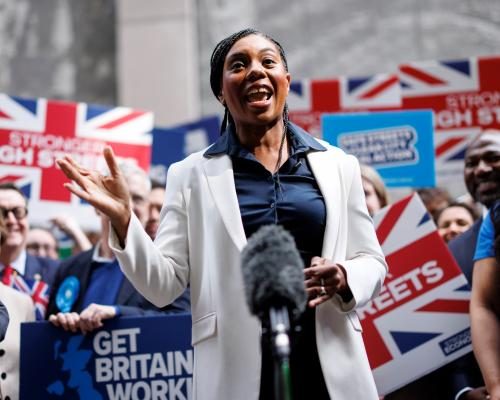
Kemi Badenoch, the Conservative Party's Secretary of State for Business and Trade, proclaimed that the Tories are "coming back" following their recent victory in regaining control of the Westminster council from Labour. This assertion comes despite the party experiencing notable losses across various regions in England during Thursday's local elections. The Conservatives managed to fend off competition from Reform UK in Bexley, yet they faced a harsh reality in Essex, where Badenoch herself serves as an MP, losing 13 seats while Reform UK made significant gains, acquiring 52 seats.
Despite the setbacks, the Conservatives successfully retained control in Harlow, winning all 11 available district council seats. However, the situation was dire in Havering, where the party's representation was completely eradicated, falling from 14 councillors to none. Reform UK emerged as the dominant party in the area, claiming 39 of Havering's 55 councillor positions, while the Havering Residents' Association became the official opposition with 11 councillors. Labour held onto two of the four seats available, alongside three independents. Originally reported by The Guardian.
Conservative Losses and Reform Gains
The local elections revealed a mixed bag for the Conservatives, with significant losses in Essex where Reform UK took control of the county council, ending the Conservatives' 25-year governance. Kemi Badenoch, addressing party activists in Westminster, highlighted the party's successes in London, stating, "We have done brilliantly in Westminster," and pointed to their reclaiming of Wandsworth as a notable achievement. "People said nobody even expected anything to happen in Wandsworth. Wandsworth is now under Conservative control," she added.
In addition to their challenges in Essex, the Conservatives lost control in Hampshire for the first time since 1997, a development that underscores the shifting political landscape. Reform UK's influence has also been felt in regions like Suffolk, where they seized control of the county council, and made further gains in areas such as Brentwood and North East Lincolnshire, amplifying the pressure on the Conservatives.
Mixed Reactions from Conservative Leaders
Bernard Jenkin, long-serving MP for Harwich and North Essex, labeled the Tory losses in Essex as "mortifying." He expressed curiosity about how Reform UK would manage Essex, emphasizing that the political dynamics in Kent showed that the Conservative vote had started to recover. "What we are seeing is that the Conservatives have already troughed and are on an upward trajectory, whereas Reform seem to have already peaked," he commented.
When asked about the potential for a Conservative-Reform alliance in the next general election, Jenkin noted that it would largely depend on the polling status of each party as the election nears. He cautioned against drawing hasty conclusions from the election results, recalling how the Social Democratic Party (SDP) had once polled at 50%, yet Margaret Thatcher secured a decisive victory the following year. Jenkin remarked, "Nigel Farage is very keen to paint this earthquake as a permanent state, but he would say that wouldn't he."
Analysis of the Political Landscape
Political analysts are weighing in on the results, noting that both the Conservatives and Labour seemed to perform better in London compared to the rest of the country. Professor Tony Travers from the London School of Economics remarked, "The Tories have done surprisingly well, hanging on to Bexley, winning back Westminster and becoming the biggest party in Wandsworth." He highlighted that the mixed results for Labour and the Liberal Democrats in London indicate that voters in the capital are seeking stability rather than radical changes.
Peter Kellner, former president of YouGov, pointed out that while the Conservatives still lag behind Reform UK, their performance was an improvement from last year, when they faced a loss rate of 68%. This time around, that rate dropped to approximately 44%. "If you compare it to historical standards or when the Conservatives were in power, it's awful - but compared with last year, they're doing slightly better and Reform are doing slightly worse," he stated.
Henry Hill, a political commentator, warned that while the Conservatives may celebrate specific victories like Westminster, they risk overlooking deeper issues within the party. "It could have been worse, this isn't as bad as last year - but that is a low benchmark," he cautioned. The Conservatives are still grappling with the fallout of an unpopular government and a diminished councillor base, placing them in a precarious position as they look to the future.
As the Conservatives navigate these challenges, the upcoming months will be crucial in determining their strategy and how they respond to the pressures from Reform UK and the electorate's shifting sentiments.
Originally reported by The Guardian. View original.