
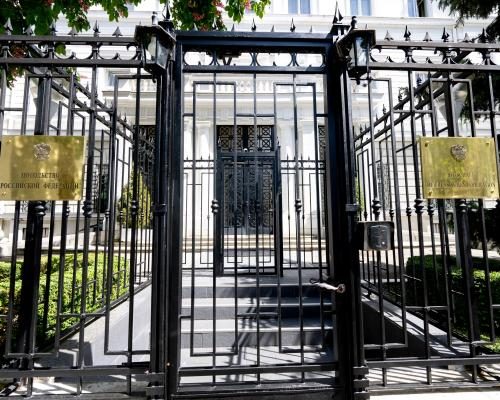
Austrian authorities have expelled three staff members from the Russian embassy in Vienna, citing concerns over espionage activities linked to a network of antennas discovered on the embassy's premises. This decision, made public by Foreign Minister Beate Meinl-Reisinger, underscores Austria's commitment to addressing longstanding espionage issues within its borders.
Espionage Allegations Prompt Diplomatic Fallout
The expulsion comes after Austrian officials uncovered a "forest of antennae" on the rooftops of the Russian diplomatic mission, which was reportedly used for illicit data collection. Beate Meinl-Reisinger labeled the use of diplomatic immunity for espionage as "unacceptable". In her remarks, she stated, "We have communicated this to the Russian side in no uncertain terms, including as regards the forest of antennae at the Russian mission." The expelled diplomats had already left Austria, and their removal marks a significant escalation in diplomatic tensions between Vienna and Moscow. Originally reported by The Guardian.
Since 2020, Austria has expelled a total of 14 Russian diplomats, indicating a growing awareness and response to espionage activities that have historically plagued the nation. Vienna, often referred to as Europe's espionage capital since the Cold War, is home to numerous international organizations, including the Organization of the Petroleum Exporting Countries and the International Atomic Energy Agency. This makes it a prime target for intelligence operations.
Reactions from Moscow and the Austro-Russian Relations
The Russian embassy responded to the expulsions with strong condemnation, labeling the decision as "outrageous", "unjustified", and "politically motivated". They have threatened to retaliate harshly, signaling potential further deterioration in diplomatic relations. Such tensions are not new; allegations of Russian espionage have frequently surfaced in Austria, with many officials calling for stronger measures to combat foreign intelligence operations.
This incident reflects a broader trend within Austrian politics, where the government faces increasing pressure to address its ongoing challenges related to espionage. Recent high-profile cases, such as the arrest of Egisto Ott, a former counter-espionage official accused of leaking sensitive information to Russian intelligence, have intensified scrutiny of Vienna's diplomatic environment.
Austria's Commitment to Combat Espionage
In response to the increasing threat of espionage, the Austrian government has announced plans to close legal loopholes that have allowed foreign spies to operate with relative impunity. Currently, Austria's criminal code provides limited options for prosecuting espionage unless the activities directly target Austrian interests. This loophole has made the country an attractive base for foreign intelligence services, with estimates suggesting that up to 7,000 secret agents may operate among the 17,000 accredited diplomats in Vienna.
Meinl-Reisinger emphasized the government's commitment to a "change of course" in national security policy. The coalition government, consisting of the conservative People's Party (ÖVP), the Social Democrats (SPÖ), and the liberal Neos, is reportedly drafting legislation that would widen the definition of espionage to include acts against EU institutions and international organizations based in Vienna.
Authorities have recognized that the current legal framework hampers their ability to combat foreign intelligence operations effectively. The former Austrian domestic intelligence agency, BVT, noted in its annual reports that the limited legal options result in a high prevalence of foreign intelligence activities within the country.
Implications of Recent Espionage Cases
The arrest of Egisto Ott, who allegedly aided Russian efforts to track down dissidents, has further spotlighted Austria's vulnerabilities. Accused of providing sensitive materials, including government phones and laptops, to Russian operatives, Ott's case has raised alarms about the extent of infiltration within Austrian intelligence services. He is alleged to have conducted unauthorized searches of police databases to assist Russian intelligence in locating Targets.
As investigations into Ott's activities continue, the Austrian government is under increased pressure to strengthen its counter-espionage measures. The proposed legislation aims not only to redefine espionage but also to enhance enforcement capabilities against foreign intelligence operations, particularly those targeting EU interests.
With tensions escalating and the potential for retaliation from Moscow, the coming weeks will be critical in shaping the future of Austro-Russian relations and addressing the pervasive issue of espionage in Vienna.
Originally reported by The Guardian. View original.