
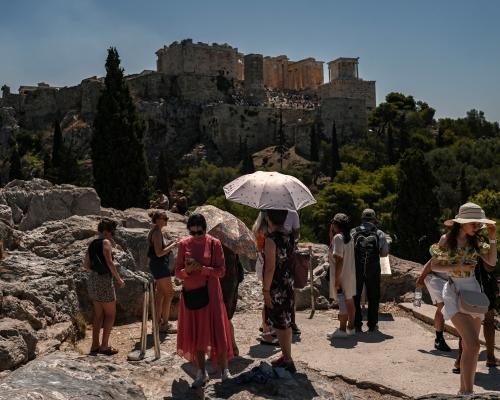
In the vibrant heart of ancient Athens, the surge of tourists has become a double-edged sword. Streets once bustling with locals now teem with visitor groups, guided by enthusiastic tour leaders. Haris Doukas, the city's socialist mayor, sees this influx not as a boon but as a harbinger of 'over-saturation'-a stark warning that could signal the end of Athens' authenticity. With more than 8 million tourists flooding the city last year, Doukas is on a mission to reclaim the capital's congested center for its residents.
Tourism Boom and Its Consequences
Once a mere stopover for travelers en route to the Greek islands, Athens has emerged as a key destination. This transformation has led to a significant uptick in short-term rentals, particularly in the popular Plaka district under the Acropolis. According to a recent municipal study, overnight stays in Plaka have more than doubled since 2018. However, this overwhelming demand has raised alarm bells for Doukas, who emphasizes the need for restrictions and regulations to safeguard the city's character. Originally reported by The Guardian.
"Athens cannot operate as if it were a giant hotel," he stated in a recent interview. Doukas is acutely aware of the pressures exerted by tourism on the city's infrastructure. With a resident population of around 700,000 and an influx of 8 million tourists, the strain is palpable. "All of Athens is being dug up so that we can cope," he noted, referring to ongoing construction efforts aimed at upgrading electricity, water systems, drainage, and even 5G networks.
Calls for Regulatory Changes
In a bid to stem the tide of uncontrolled tourist development, Doukas is advocating for a tourism land-use bill currently under discussion. This proposed legislation aims to impose a blanket ban on new business activities in Athens' historical center, particularly in Plaka. "We'll be stopping all tourist investment in Plaka, which I am on a mission to save. There's no more room. Not for short-term rentals, not for serviced apartments, not for hotels, or any other tourism use. The area is over-saturated," he declared.
Doukas's efforts coincide with broader concerns within the hospitality industry itself. Surprisingly, he found an ally in Evgenios Vassilikos, the head of Athens' hoteliers' association. Vassilikos echoed Doukas's sentiments at a recent promotional event, suggesting that the capital consider a cap on hotel construction similar to the one Barcelona imposed in 2017. "We don't need to reinvent the wheel," he stated, highlighting the critical need for Athens' tourism sector to reflect on its future direction.
Preserving Local Communities
Doukas's commitment to preserving local communities extends beyond restricting tourist investments. He has focused on making Athens more livable for its residents, particularly younger couples who are being pushed out by rising rents and property prices. "We've created a social housing office to identify buildings and apartments that we can renovate with EU funds," he explained. The mayor's administration has already planted an estimated 3,855 trees around the 15 sq mile (39 sq km) municipality, a step towards greening the densely populated capital.
The urgency for action is underscored by the impact of short-term rentals on housing affordability. Doukas describes the lack of accessible housing as the municipality's biggest problem. He noted that the need for a balanced approach to tourism and living conditions is crucial if Athens is to avoid the pitfalls seen in other major cities.
Looking to the Future
Doukas's approach reflects a broader trend among European cities grappling with the challenges of overtourism. He has drawn inspiration from Barcelona's recent measures to restrict short-term rentals, which aim to enhance livability for residents. "When the whole of Athens' center is turning into a hotel zone, I cannot be the only one saying it," Doukas remarked, indicating a willingness to engage in a larger dialogue on urban sustainability and tourism management.
As Athens navigates this critical juncture, the mayor's plans will play a crucial role in determining the city's future. By prioritizing the needs of its residents and advocating for necessary regulatory changes, Doukas hopes to ensure that Athens does not become just another tourist trap but remains a vibrant, authentic city for generations to come.
Originally reported by The Guardian. View original.