
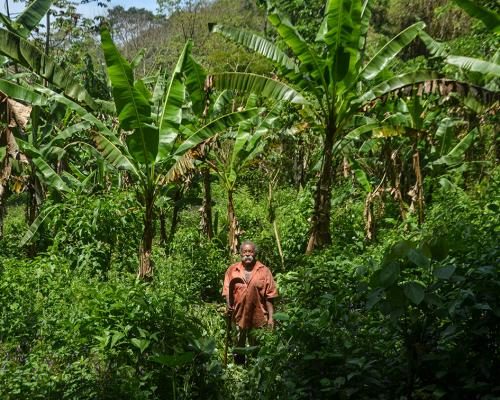
The gentle sound of scythes slicing through the air fills the hills of Vargem Grande in Rio de Janeiro, where brothers Jorge and Ubirajara Cardia diligently harvest bananas. Hailing from the Quilombola community of Cafundá Astrogilda, they practice a time-honored tradition that not only connects them to their ancestors but also plays a crucial role in conserving the world's largest urban forest.
Harvesting Tradition Meets Conservation
Every week, the Cardia brothers select bunches of prata, maçã, and Cavendish bananas from their groves, carefully cutting them down before loading the fresh produce onto their mules. They navigate through sloping paths, a journey of about 5 kilometers (3 miles), that winds through a forest shaped by both Indigenous Tupinambá people and enslaved Africans. These banana groves, cultivated by quilombola communities, exist within the Pedra Branca State Park, a designated conservation area that spans over 12,500 hectares (30,888 acres) and is part of the UNESCO-listed Atlantic Forest Biosphere Reserve. Originally reported by The Guardian.
For these families, banana farming offers more than just financial gain; it provides food security while simultaneously preserving biodiversity. Jorge notes that their agroforestry methods demand less labor, allowing nature to thrive with minimal intervention. "In agroforestry, the management of banana crops demands less work, and we save time as we only need to prune the banana plant. Then, nature, with its own rhythm, does all the rest," he says.
The Vital Role of Agroforestry
The Cardia brothers' banana plantations are not mere agricultural endeavors but represent a model of sustainable farming that intertwines crops, livestock, and trees. The landscape features a variety of native and non-native species, including embaúba, carrapeta, jacatirão, and jabuticaba, creating a vibrant ecosystem. This agroforestry system stands in stark contrast to conventional agribusiness practices that often lead to monoculture and environmental degradation.
"I call it 'agriculture of life' because this way of growing food cherishes the forest, the water, the space we live in," Jorge proudly remarks. His sentiments echo the views of Sarah Rubia Nunes, who also comes from a lineage of banana growers. As the manager of AgroVargem, an organization of small-scale farmers operating within the state park, Nunes emphasizes that agroecology is more than just farming; it embodies a lifestyle and choices that reflect their desired future.
Challenges and Resilience
Despite their deep-rooted connection to the land, the banana growers have faced significant challenges. When Pedra Branca State Park was established in 1974, authorities sought to restrict the use of land by local farmers, including prohibiting the cultivation of exotic species like bananas, which were deemed harmful to native flora. Many farmers, however, chose to remain, and what began as a temporary situation evolved into a permanent presence, allowing them to adapt their practices to the park's changing ecosystem.
Over the years, species that thrive in sunlight, such as embaúba and grandiúva, flourished alongside the banana plants, contributing to the emergence of prosperous agroforestry systems in the region. Annelise Fernandez, an environmental sciences professor at the Rural Federal University of Rio de Janeiro, notes that the ongoing tension between local farmers and authorities reflects a broader issue: the failure to recognize the crucial role traditional communities play in ecosystem preservation. "Parks are generally created in a very unilateral way, causing forced eviction and deterritorialising the communities," she explains.
Preserving Biodiversity Through Tradition
Despite these challenges, Nunes and others remain steadfast in their commitment to sustainable farming. They argue that traditional banana cultivators have never harmed the forest; instead, their practices have inadvertently contributed to its conservation. According to the Food and Agriculture Organization of the UN, agroforestry systems can sustain up to 80% of the biodiversity found in natural forests while improving soil health, water management, and resilience against climate change.
In 2010, after decades of struggle for land rights, the State Institute of the Environment acknowledged the vital role these farmers play in the management of the park. As the community continues to navigate the complex interplay of conservation and agriculture, it stands as a testament to the potential of traditional practices to foster sustainability and resilience in urban environments.
As these families persist in their efforts, they not only cultivate bananas but also nurture a profound connection to the land, ensuring that the rich biodiversity of the Pedra Branca State Park thrives for generations to come.
Originally reported by The Guardian. View original.