
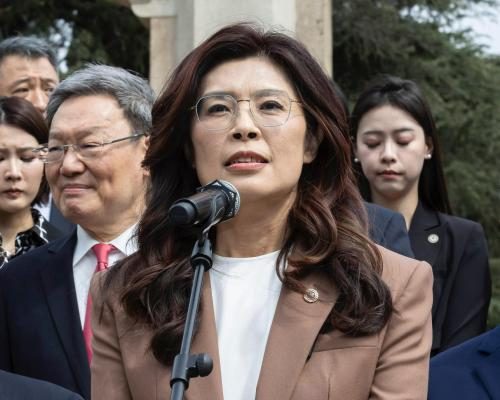
In a historic meeting on Friday, Chinese President Xi Jinping met with Taiwan's opposition leader Cheng Li-wun in Beijing, marking the first direct dialogue between the two sides in a decade. During the meeting, Xi asserted that people on both sides of the Taiwan Strait are Chinese and desire peace, a statement that reflects China's ongoing interest in Taiwan's political landscape.
Controversial Visit Sparks Debate in Taiwan
Cheng Li-wun, who chairs Taiwan's Kuomintang (KMT), arrived in China earlier this week, visiting several cities before reaching Beijing. Her trip has ignited controversy at home, with detractors accusing her of being too sympathetic to Beijing. This sentiment is particularly pronounced given that many Taiwanese view the Chinese government as a threat to their sovereignty. Cheng has previously articulated that identifying as Chinese is a "very natural thing," a perspective that sharply contrasts with prevailing public opinion in Taiwan. Recent polls indicate that approximately two-thirds of the population identify primarily as Taiwanese rather than Chinese. Originally reported by The Guardian.
During her meeting with Xi, Cheng emphasized that Taiwan should "no longer be a flashpoint for potential conflict" but instead become "a symbol of peace jointly safeguarded by Chinese people on both sides of the strait." Her remarks underscore her push for a more conciliatory approach towards Beijing, a stance that is gaining traction among some KMT supporters but remains contentious among a populace wary of China's intentions.
Historical Context of KMT and CCP Relations
The tensions between Taiwan and China have deep historical roots. The KMT governed China until its defeat by the Chinese Communist Party (CCP) in 1949, after which it retreated to Taiwan. Since then, Taiwan has operated as a self-governing entity, a status that Beijing has consistently challenged, claiming Taiwan as part of its territory. Cheng's journey to China included a visit to Nanjing, a city rich in KMT history, highlighting the party's legacy and its complicated relationship with the mainland.
Since the DPP, a pro-sovereignty party, came to power in Taiwan in 2016, relations with Beijing have soured significantly. The CCP has intensified military maneuvers around Taiwan, raising concerns of a potential blockade. Cheng's leadership of the KMT, which has traditionally advocated for closer ties with China, positions her as a polarizing figure in Taiwan's current political climate.
Domestic Political Implications of Cheng's Visit
Cheng's visit is set against a backdrop of contentious domestic politics. The Taiwanese legislature is embroiled in debates over a proposed $40 billion special defense budget, with the DPP attempting to push it through. Opposition parties, including the KMT, have criticized the budget for being excessively large and vague. Cheng has denied accusations from the DPP that her party has aimed to obstruct the budget discussions ahead of her meeting with Xi.
The KMT has instead proposed a reduced defense budget of $12 billion, focusing on specific military items approved for sale by the United States. This approach aligns with Cheng's narrative that fostering closer ties with Beijing could alleviate tensions and ensure Taiwan's security, contrasting sharply with the DPP's stance, which emphasizes self-defense.
Beijing's Strategy to Influence Taiwan's Politics
By hosting Cheng, Beijing aims to sow doubt regarding the DPP's self-defense policies and to strengthen pro-unification sentiments within Taiwan. Amanda Hsiao, China director at the Eurasia Group think tank, remarked that Beijing seeks to maintain division within Taiwan regarding the best strategy for securing its future. The growing skepticism of the U.S. in Taiwan may bolster Cheng's argument that her party is better equipped to navigate cross-strait relations.
Chinese state media have been particularly critical of DPP leader Lai Ching-te, who won the presidency in 2024, portraying him as an adversary of peace. This portrayal reflects the CCP's strategy to leverage Cheng's meeting with Xi to influence perceptions in Taiwan and potentially sway U.S. policy, particularly concerning arms sales.
William Yang, a senior analyst at the International Crisis Group, noted that China hopes to convey to U.S. President Donald Trump that its ally in Taiwan aligns with Beijing on key issues. As Xi and Trump are expected to meet next month in Beijing, the stakes for Taiwan's future become even more pronounced.
As the political dynamics in Taiwan continue to evolve, Cheng's approach may face increasing scrutiny from a public that remains wary of Beijing's intentions. The trajectory of cross-strait relations remains uncertain, with significant implications for regional stability.
Originally reported by The Guardian. View original.