
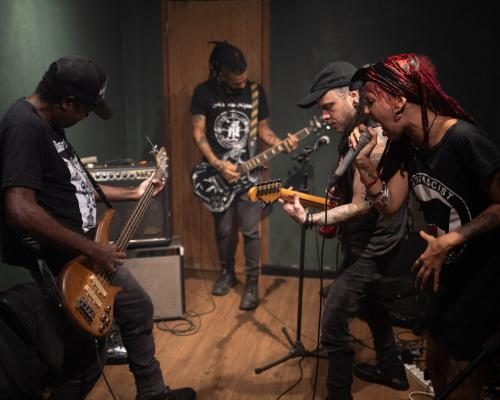
As police charged into the Morro da Lagartixa favela in Rio de Janeiro, chaos erupted. Rodrigo Cilirio, founder and bassist of the punk band Repressão Social, ducked for cover, shouting, "Holy shit! All those guns! Things are getting ugly!" His fear encapsulated the ongoing struggle against urban violence, police brutality, and social inequality that plagues Brazil's cities. For over three decades, Cilirio's music has served as a powerful vehicle for expressing anger and frustration against the systemic injustices faced by marginalized communities.
The punk movement, which originated in the UK and US during the 1970s, has found a robust following in Brazil, particularly in the working-class areas of cities like São Paulo, Belo Horizonte, and Rio de Janeiro. "Punk started over in Europe but it became much stronger here because the violence is so much worse," Cilirio explained, reflecting on the conditions that have shaped the local scene. In Brazil, the music embodies a direct response to police militarization, poverty, and the rampant violence that disproportionately affects young black men. Originally reported by The Guardian.
Repressão Social: A Voice of Resistance
Repressão Social, formed in 1995, emerged from the heart of Morro da Lagartixa, a community marked by hardship and strife. Cilirio described punk as a vital outlet: "It's my way of letting it all out so I don't choke to death. It's my voice." The band's lyrics tackle harsh realities, addressing themes of police violence, poverty, and the struggles of everyday life in Brazil's favelas. Cilirio, who is often called Abutre (Vulture) due to his distinctive black attire, highlighted the stark contrast between the affluent neighborhoods and the squalor of the favelas, drawing parallels to Brazil's colonial past.
"This is the modern-day senzala," he said, referring to the slave quarters of the past, as he lamented how society has relegated the poor to marginalized areas, indifferent to their plight. The stark socioeconomic divide serves as fertile ground for punk music, which thrives on themes of rebellion and resistance. As the band rehearses, fueled by cheap drinks and cigarettes, the raw energy and urgency of their message reverberates through the cramped practice space.
The Voice of a New Generation
Vic Morphine, the band's fiery vocalist, resonates with Cilirio's sentiments. Living in Rio's oldest favela, Providência, she feels compelled to channel her anger into music. "We feel angry - and we have reason to be," Morphine, 31, said passionately. For her, punk is more than a genre; it's a way of life, a method of articulating outrage against systemic injustices, particularly the violence that women face. She connects her experiences in the punk scene to a broader historical narrative of resistance and uprising in Brazil.
During a recent performance, Morphine delivered a fierce rendition of a song condemning the brutality of contemporary life. "Massacres! Murders!. They snatch you! They kill you! There is no more hope!" she shouted, her raw emotion electrifying the audience. The crowd roared in response, embodying the spirit of protest that punk music has historically represented. The punk movement in Brazil has become a platform for voicing collective frustration and a call for societal change.
Punk's Global Influence
As punk celebrates its 50th anniversary, its influence extends beyond Brazil, resonating with youth in various parts of the globe. Kevin Dunn, author of Global Punk: Resistance and Rebellion in Everyday Life, noted that the genre has adapted to local contexts, becoming a medium for marginalized voices worldwide. From Indonesia to Colombia, punk has transformed into a flexible form of resistance, integrating local musical traditions while addressing universal themes of frustration and discontent.
Dunn emphasized that the movement's growth in the Global South reflects a response to oppressive conditions. "The global south has really embraced punk culture as a way to respond to their own individual and local contexts," he said. This adaptability has allowed punk to thrive in various social landscapes, making it a powerful tool for expressing dissent and advocating for change.
Brazil's punk scene continues to push boundaries, challenging societal norms and advocating for the rights of the oppressed. As bands like Repressão Social amplify their voices, they embody a spirit of resilience and defiance that resonates strongly in a country grappling with deep-rooted issues of inequality and violence. The anger that drives their music is a testament to the enduring power of punk-a sound that refuses to be silenced.
Originally reported by The Guardian. View original.