
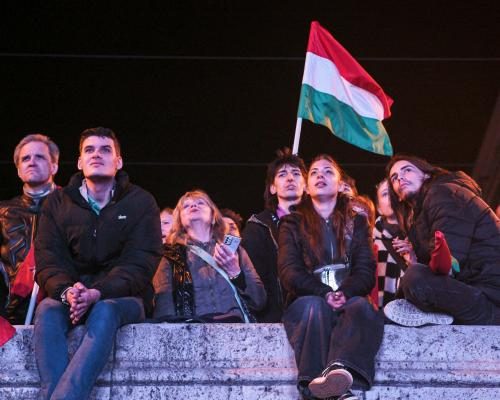
Viktor Orbán, Hungary's long-serving Prime Minister, faced a surprising electoral defeat on April 12, 2026, at the hands of Peter Magyar's Tisza party. This unexpected shift marks a potential turning point not only for Hungary but also for Europe's democratic landscape, as many see it as a rejection of Orbán's 16-year rule characterized by corruption and autocratic tendencies.
Symbols of Excess and Corruption
As historians reflect on Orbán's downfall, they might find themselves noting bizarre details-like the zebras seen roaming the grounds of a lavish palace owned by Orbán's family, or the 72 golden toilet brushes purchased for nearly €10,000 during renovations at Hungary's central bank. Such extravagances became emblematic of the rampant corruption associated with Orbán's ruling party, Fidesz. Reports indicated that this corruption significantly harmed Hungary's economy, leading to its poor rankings on European Union corruption indices. Originally reported by The Guardian.
Opposition to these excesses, coupled with widespread discontent over how corruption impacted citizens' livelihoods, fueled the electoral backlash against Orbán. Peter Magyar's Tisza party achieved a remarkable victory, despite an electoral system skewed in favor of Fidesz, indicating a desperate desire among Hungarians to restore their democracy.
The Significance of Magyar's Victory
The ease with which Orbán conceded defeat after the election results came in is seen as a significant moment for liberal democracy in Europe. Nathalie Tocci, a noted columnist, articulated this sentiment, stating that the outcome represents a victory for liberalism globally, not just in Hungary. Historian Timothy Garton Ash, who observed Hungary's transition from communism in 1989, expressed cautious optimism that Hungary could reverse the erosion of its democracy. The real challenge, he argues, lies in whether Europe has the political will and creativity to support this process.
Magyar's Tisza party now holds a critical "supermajority" with 70% of seats in parliament, empowering them to dismantle the structures that have upheld Orbán's regime. While Magyar has acknowledged his past ties to the Fidesz government, he has promised to pursue accountability for those who "plundered, looted, betrayed, indebted and ruined" Hungary. His immediate focus appears to be on mending relations with the EU, which many Hungarians desire, indicating a shift away from Orbán's confrontational stance.
Implications for European Relations
Orbán's ousting also poses significant geopolitical implications. His alignment with Russia had drawn criticism and concern, with many viewing Hungary as a "Trojan horse" within the EU. With Magyar at the helm, expectations for a thaw in relations with Brussels are high. He has emphasized a desire to avoid unnecessary conflict with the EU, which may facilitate the release of €17 billion in frozen EU funds essential for Hungary's economy.
However, Magyar's approach to Russia remains cautious. While he recognizes the geographical realities that bind Hungary to Russia, he has framed the recent election as a choice between Eastern and Western alliances, signaling a commitment to a more pro-Western policy direction. Observers are keenly interested in how he will address Hungary's veto on a crucial €90 billion loan for Ukraine.
Impact on Global Populism
Orbán's loss also reverberates beyond Hungary, particularly within the context of global populism. His relationship with Donald Trump and the broader MAGA movement positioned Hungary as a testing ground for populist governance, and his ousting is a significant blow to that narrative. Political analysts suggest that the defeat of Orbán carries "symbolic and psychological significance" for American politics, as it suggests that the populist tide may be turning.
With this election, there is a renewed sense of hope for liberal democratic values in Hungary and beyond. While Magyar is not a liberal in the traditional sense, his commitment to restoring democratic institutions indicates a willingness to move past Orbán's autocratic legacy.
As Europe watches closely, the implications of this electoral shift could shape the continent's political landscape, fostering a renewed commitment to democratic principles and cooperative governance. The question remains whether Hungary can lead the way in reclaiming democracy from the clutches of populism.
Originally reported by The Guardian. View original.