
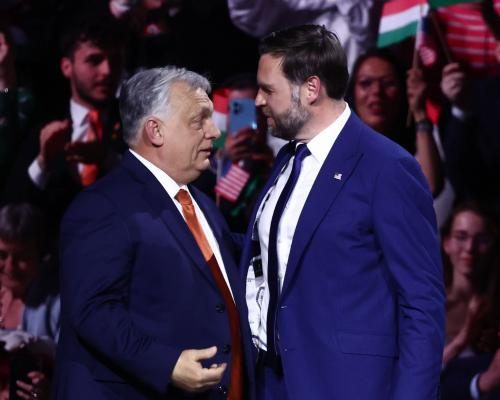
In a significant political shift in Hungary, Viktor Orbán has lost the recent elections to Péter Magyar, prompting reactions from U.S. officials and international leaders. U.S. Vice President JD Vance expressed his disappointment over Orbán's defeat but emphasized that the U.S. will collaborate with the new Magyar government. This pivotal moment comes as Ukraine's President Volodymyr Zelenskyy meets with German Chancellor Friedrich Merz in Berlin, highlighting Germany's role as Ukraine's primary ally amid its ongoing conflict with Russia.
U.S. Reaction to Hungary's Election Results
Vice President JD Vance, who had traveled to Budapest in the days leading up to Hungary's election, voiced his sorrow regarding Orbán's loss during an appearance on Fox News. Vance stated, "I'm sad that [Orbán] lost," but reassured audiences that the Biden administration is ready to work with the new Hungarian prime minister, Péter Magyar. Vance defended his visit, clarifying that his intention was not to interfere with the election but to acknowledge Orbán's long-standing support for U.S. interests against European Union regulations. He highlighted Orbán as a rare European leader willing to stand up to EU bureaucracy that often negatively impacts American businesses. Originally reported by The Guardian.
Furthermore, Vance noted, "He's one of the few European leaders we've seen who's been willing to stand up to the bureaucracy in Brussels that has been very, very bad for the United States." This perspective underscores the complex relationship between the U.S. and Hungary, where political dynamics often intertwine with economic interests.
Magyar's Ascendancy and Challenges Ahead
Péter Magyar, who recently emerged victorious in the elections, is set to meet with Hungarian President Tamás Sulyok to discuss the formation of his government. This meeting may prove challenging, given Magyar's previous calls for Sulyok, a loyalist to Orbán, to resign from his position. Magyar had criticized Sulyok, stating, "He was appointed to sign everything; every document that he is presented with - whether it's the menu or the constitution or the laws - so we don't need people like that. To me, he is not the president." Such comments reflect the tensions that may surface as the new administration seeks to distance itself from Orbán's legacy.
Magyar's government is expected to address various pressing issues facing Hungary, including economic recovery and relations with the EU. As public sentiment shifts toward a desire for change, how Magyar navigates these challenges will be critical in determining the future trajectory of Hungary's political landscape.
Ukraine and Germany Strengthen Ties Amid Conflict
Meanwhile, President Volodymyr Zelenskyy is meeting with German Chancellor Friedrich Merz in Berlin today, marking a continuation of Ukraine's efforts to solidify its support from Germany. Zelenskyy's administration recognizes Germany as its most significant ally in the ongoing war against Russia, especially after the United States under President Donald Trump reduced its support. The discussions between the two leaders are expected to cover joint defense initiatives, including collaborations on drone technology, which is crucial for Ukraine's military strategy.
Joining Zelenskyy in Berlin are several key Ukrainian ministers, including Foreign Minister Andrii Sybiha, Energy Minister Denys Shmyhal, and Economy Minister Oleksii Soboley. This meeting highlights Ukraine's strategy to reinforce its alliances with European nations while navigating the intricacies of international relations amid ongoing hostilities with Russia.
Implications for European Political Climate
The outcomes of both the Hungarian elections and Zelenskyy's meeting with Merz could have far-reaching implications for the European political climate. The shift in Hungary's leadership signals potential changes in its approach to EU relations, especially as Magyar may seek to redefine domestic policies and international partnerships. The U.S. administration's willingness to engage with the new Hungarian government may also set a precedent for how Washington handles relationships with other European nations in flux.
As these political developments unfold, the interplay between Hungary's new leadership and the ongoing conflict in Ukraine will be closely watched. The U.S. commitment to maintaining strong ties with both Hungary and Ukraine illustrates a broader strategy to navigate shifting alliances in Europe amid challenges posed by Russia's aggressive posture.
As the day progresses, further reactions from across Europe are anticipated, shedding light on the evolving political landscape and its potential consequences for international relations.
Originally reported by The Guardian. View original.