
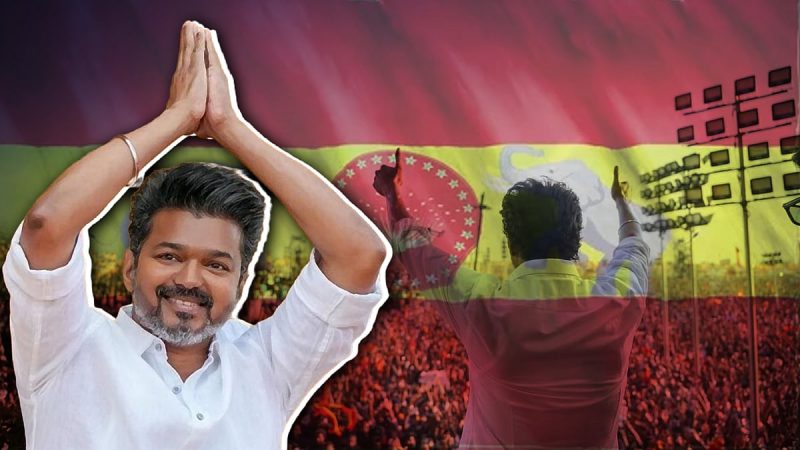
In a significant shift for Tamil Nadu's political landscape, popular film star Vijay has ventured into politics by founding the Tamilaga Vettri Kazhagam (TVK) in 2024. This move comes after decades of building a loyal fanbase and a carefully crafted on-screen persona that positions him as a protector and leader among his followers. With a history of inspiring lines and a cinematic legacy, Vijay aims to translate his popularity into political influence.
Crafting a Persona: From Screen to Stage
Vijay has long been revered not just as an actor but as a cultural icon in Tamil Nadu. His journey began with the 2010 film Sura, where he declared, "I have honesty and courage in my heart. Above all, I have a crowd willing to give their lives for me." This declaration resonated with audiences and laid the groundwork for his public image as Thalapathy, meaning 'commander.' Over the years, this persona has morphed into a symbol of hope and resilience for many, encapsulating the values of courage and leadership.
The roots of Vijay's political aspirations can be traced back to 2009 when he introduced a flag for his fan clubs adorned with the slogan "Unnal Mudiyum," which translates to "You can do it." This catchphrase has become a rallying cry among his fans, hinting at his ambitions that extend beyond the silver screen. As the political landscape in Tamil Nadu has been predominantly shaped by the two major parties - the Dravida Munnetra Kazhagam (DMK) and the All India Anna Dravida Munnetra Kazhagam (AIADMK) - Vijay's foray into politics represents a potential shift in the status quo.
The Political Landscape of Tamil Nadu
Tamil Nadu's political environment has historically been a battleground for the DMK and AIADMK, both of which emerged from the Dravidian movement focused on social justice and Tamil identity. Since the late 1960s, power has oscillated between these two parties, with smaller factions typically aligning with one or the other. Currently, the DMK, led by Chief Minister MK Stalin, governs, while the AIADMK serves as the principal opposition. In this entrenched two-party system, Vijay's Tamilaga Vettri Kazhagam seeks to carve out a new space.
Vijay's political strategy appears to leverage his existing fanbase and the emotional connection he has established over the years. The challenge lies in converting this cinematic adoration into tangible electoral support. Observers have noted that his experiences and relationships in the film industry could lend him an edge, but the complexities of electoral politics in Tamil Nadu remain formidable. Given the fierce loyalty of his fans, Vijay's entry into politics could disrupt traditional voting patterns, prompting both excitement and skepticism.
The Fan Phenomenon and Its Implications
Vijay's fanbase is not just a group of admirers; it's a deeply engaged community that views him as an extension of their lives. His fans often refer to him as anna, meaning elder brother, reflecting a familial bond that transcends the conventional actor-fan relationship. This emotional investment has been pivotal in building a sustained and passionate following, which he now seeks to mobilize politically.
In early 2021, Vijay made headlines when he cycled to a polling booth in Chennai to cast his vote during the state Assembly elections. This seemingly simple act turned into a spectacle as fans flocked to support him, resulting in traffic disruptions and police intervention. Speculation arose that his choice of transport was a subtle protest against rising fuel prices under the AIADMK government. However, his publicist downplayed the political implications of the act, emphasizing it as a personal decision. This incident highlights the fervor surrounding Vijay and poses the question of whether such moments can be effectively channeled into a political movement.
Vijay's Vision for TVK and Future Challenges
The formation of Tamilaga Vettri Kazhagam signifies more than just a political party; it serves as a continuation of Vijay's cinematic narrative and his aspirations for societal change. He aims to resonate with the everyday struggles of the Tamil populace, utilizing his cinematic themes of justice and empowerment as cornerstones of his political message. However, the transition from film to politics will not be without its challenges.
As Vijay embarks on this ambitious journey, the critical question remains: Can he transform the roar of applause from cinema halls into a formidable electoral force? In a state known for its vibrant and tumultuous political history, the road ahead for Vijay and TVK is laden with both opportunities and obstacles. The upcoming elections will serve as a litmus test for Vijay's political aspirations and the potential reconfiguration of Tamil Nadu's political scene.