
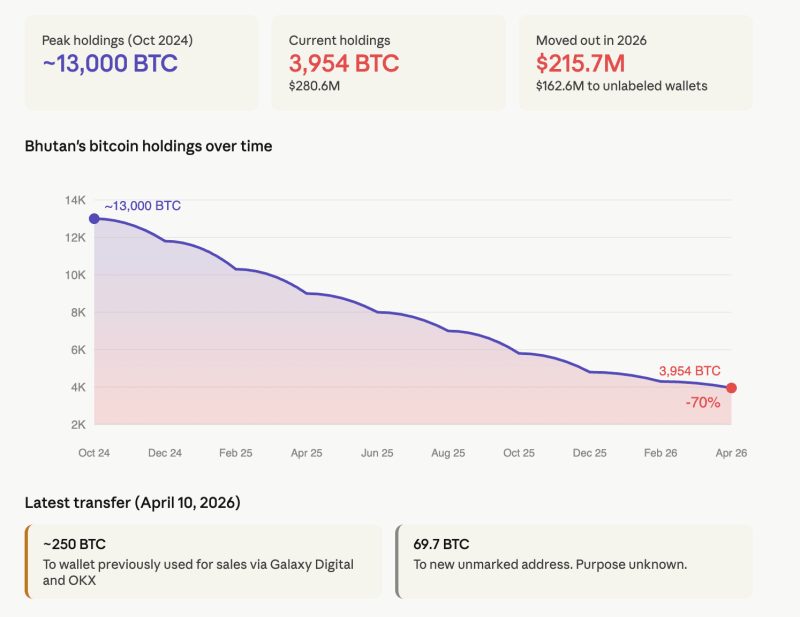
In a significant turn of events, Bhutan has sold off 70% of its bitcoin reserves over the past 18 months, marking the end of what was once a pioneering experiment in sovereign bitcoin mining. This week, the Royal Government of Bhutan transferred approximately 319.7 BTC, valued at $22.68 million, to two distinct wallet addresses, according to data from Arkham Intelligence.
Details of the Recent Bitcoin Transfers
On Thursday, Bhutan executed a notable transaction involving nearly 320 BTC. Of this amount, around 250 BTC was directed to a wallet previously associated with sales routed through Galaxy Digital and OKX. The remaining 69.7 BTC was sent to an unmarked address, suggesting a continued strategy of liquidating assets. This recent sale is part of a broader trend where Bhutan has steadily reduced its bitcoin holdings, which stood at approximately 13,000 BTC in October 2024, down to just 3,954 BTC today, reflecting a staggering reduction of about 70%. Learn more on Investopedia.
Arkham Intelligence's data reveals that Bhutan has moved approximately $215.7 million worth of bitcoin out of its holding addresses this year alone, with $162.6 million of that amount being transferred to unidentified wallets. This shift stands in stark contrast to the actions of other major Bitcoin holders, many of whom are opting to accumulate rather than sell.
Bhutan's Unique Bitcoin Mining Operations
The Royal Government of Bhutan had initially ventured into bitcoin mining through its sovereign wealth fund, Druk Holding and Investments, leveraging the country's vast hydropower resources. This strategy allowed Bhutan to mine Bitcoin at a lower cost, creating a proof-of-concept for sovereign-level bitcoin mining. However, since Bhutan's foray into this digital currency, the dynamics of cryptocurrency mining have changed dramatically.
With the current price of bitcoin hovering around $71,000 and mining difficulty reaching new heights, the profitability of Bhutan's operations has come under Pressure. The post-halving reduction of block rewards to 3.125 BTC has further strained the margins for small-scale mining operations. Ironically, the hydropower that once made mining feasible may now yield more revenue from electricity sales to neighboring India than from bitcoin mining itself.
The Future of Bhutan's Bitcoin Experiment
Questions arise about whether Bhutan's bitcoin mining operation is still active, as Arkham data indicates that the last significant bitcoin inflow from this venture occurred over a year ago. The government, which once thrived on generating digital currency from its natural resources, seems to be transitioning towards simply liquidating its accumulated assets without generating new supply. Despite multiple attempts to reach Druk Holdings for comment, there has been no response regarding the status of its mining operations.
This ongoing liquidation comes as global investment strategies shift. For instance, institutions like Strategy recently purchased 4,871 BTC for $330 million, increasing its total holdings to 766,970 BTC, while U.S. spot ETFs absorbed approximately 50,000 BTC in March alone. Even the Ethereum Foundation made headlines by staking $93 million worth of ether in a single day instead of selling it. In contrast, Bhutan stands out as the only sovereign entity publicly liquidating its crypto assets.
Implications for Future Cryptocurrency Strategies
As Bhutan moves away from its bitcoin mining operations, the ramifications extend beyond the kingdom. The country's unique approach to cryptocurrency investments may serve as a case study for other nations contemplating similar ventures. The declining profitability of bitcoin mining, particularly for smaller operations, raises concerns about the viability of such initiatives in the current economic climate.
Bhutan's shift from an active player in the bitcoin mining landscape to a seller of its assets highlights the volatile nature of cryptocurrency. As market conditions evolve, other nations may need to reconsider their strategies concerning digital currencies, weighing the benefits against the inherent risks.
The future of Bhutan's engagement with cryptocurrencies remains uncertain, but this reduction in bitcoin holdings signals a transformative phase for the nation. The kingdom's journey serves as a poignant reminder of the challenges faced by countries entering the burgeoning world of digital assets.
Originally reported by Plato Data Intelligence. View original.