
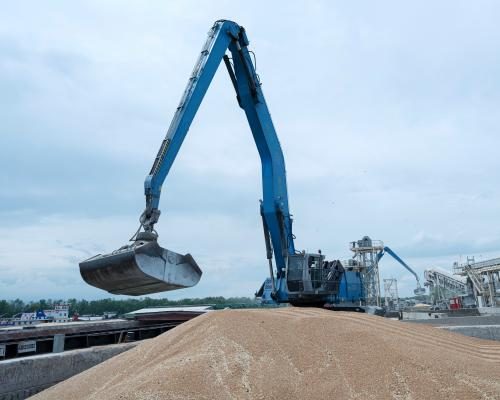
In a significant development amid ongoing tensions surrounding the Ukraine war, Ukrainian authorities have successfully halted the unloading of a ship believed to be transporting stolen Ukrainian grain to Israel. The vessel, named Panormitis, departed Israel's territorial waters after intense condemnation from Kyiv, marking a notable victory for Ukraine in its efforts to combat the illegal grain trade. Ukrainian President Volodymyr Zelenskyy has signaled a commitment to a "more systematic" campaign against what he termed the "shadow grain fleet," which includes vessels illegally exporting grain from areas occupied by Russia.
"We will systematically act against the shadow grain fleet, in the same way we act against the shadow oil fleet," Zelenskyy asserted, emphasizing Ukraine's resolve to protect its agricultural resources. The country's prosecutor general, Ruslan Kravchenko, reported that the Panormitis was forced to return to neutral waters following a series of procedural measures implemented by Ukraine. This action serves as a clear warning to operators of similar vessels. Originally reported by The Guardian.
Ukraine's Ongoing Efforts Against Illicit Grain Trade
Ukrainian officials have expressed a strong commitment to monitoring and addressing illegal grain shipments. Andrii Sybiha, Ukraine's foreign minister, stated, "We will continue to track the vessel and warn against any operations with it. This is also a clear signal to all other vessels, captains, operators, insurers, and governments: do not buy stolen Ukrainian grain. Do not become part of this crime." This proactive stance indicates Ukraine's determination to safeguard its agricultural interests and counteract Russia's attempts to exploit resources from occupied territories.
Reports from the Jerusalem Post indicate that Israel's grain importers association has acknowledged the challenges posed by the Panormitis, stating that the importing company was compelled to turn away the vessel. The company, known as Zenziper, did not respond to requests for comment regarding the situation. Meanwhile, Swedish authorities have reportedly taken action to seize another bulk carrier, the Caffa, allegedly linked to the illegal export of Ukrainian grain, further illustrating the broader international implications of this issue.
Ukrainian Strikes on Russian Oil Facilities
Beyond the grain conflict, Ukraine's military has launched a series of strikes targeting Russian oil facilities. The Ukrainian Security Service (SBU) reported a successful drone attack on the Lukoil-owned oil refinery in Perm, located over 1,500 kilometers from Ukraine. This facility is one of Russia's largest, with an annual capacity near 13 million metric tonnes. Ukrainian forces also targeted a refinery in Orsk, situated in Russia's Orenburg region, causing a significant fire. The Ukrainian general staff confirmed the attack, stating, "A strike was recorded, followed by a fire on the territory of the enterprise. The facility is involved in supplying the Russian occupation army."
These military actions underscore Ukraine's strategy of hitting critical infrastructure in Russia to disrupt supply lines and weaken the Kremlin's war efforts, illustrating the ongoing escalation in the conflict.
Global Reactions and Future Implications
On the international front, discussions have emerged regarding Japan's potential contribution to Ukraine's military capabilities. Following recent relaxations in its weapons-export rules, Japan may one day supply military equipment to support Ukraine's defense against Russian aggression. Yurii Lutovinov, Ukraine's ambassador to Japan, has indicated that a Japanese drone firm, Terra Drone, plans to boost its investment in Ukrainian defense technology by partnering with Ukrainian company WinnyLab.
However, Ukraine is not currently among the 17 countries with which Japan has defense equipment agreements. Initial arms sales will prioritize nations like the US, UK, and Australia, meaning any direct support for Ukraine could take time. Japan's existing energy ties with Russia, particularly its imports of liquefied natural gas from the Sakhalin-2 project, complicate Tokyo's ability to provide military assistance.
As Ukraine continues to navigate the complexities of international support and combat the ramifications of the war on its agricultural sector, the situation remains fluid. The successful prevention of illegal grain shipments demonstrates Ukraine's commitment to protecting its resources, while the military strikes against Russian facilities signal a broader strategy aimed at diminishing Russia's operational capabilities.
Originally reported by The Guardian. View original.