
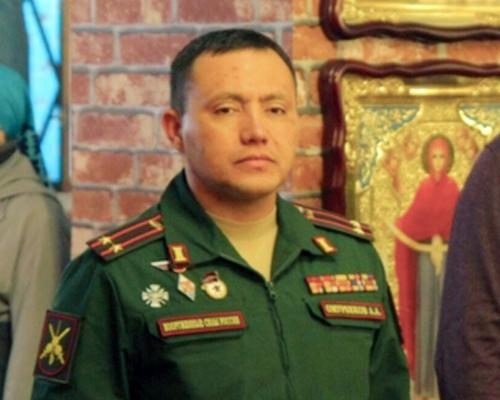
An explosion in a military settlement in Russia's far east has resulted in the death of an army officer, following an apparent assassination attempt on Major General Azatbek Omurbekov, infamous for his role in the Bucha massacre. The blast occurred on Tuesday morning in Knyaze-Volkonskoye-1, a secluded area known for its dense military presence.
According to three sources familiar with the incident, the bomb detonated around 9 AM in a residential block primarily occupied by military personnel. The explosive device had been placed in a mailbox situated between the first and second floors, and it was reportedly equipped with a camera to monitor the attack. However, the intended target, Omurbekov, was not harmed, as the bomb detonated at a different entrance, resulting in the death of a subordinate officer identified only by the surname Kuzmenko. Originally reported by The Guardian.
Background on Major General Omurbekov
Maj Gen Azatbek Omurbekov commanded Russian forces during the 2022 occupation of Bucha, a Ukrainian town where over 400 civilians were reportedly killed. His leadership has drawn international condemnation, leading the European Union to impose sanctions against him for alleged war crimes. Omurbekov's actions during this period have contributed to his moniker, the "Butcher of Bucha," a title that underscores the brutality attributed to his command.
Despite overwhelming evidence of civilian casualties, Russian officials have consistently denied any wrongdoing by their troops. In fact, Omurbekov was awarded the title of Hero of the Russian Federation by Vladimir Putin in a secret ceremony, a reflection of his significant status within the military establishment. Following his recognition, he was reassigned to the 392nd District Training Centre in Knyaze-Volkonskoye-1, which is situated close to the Chinese border and heavily fortified against outside access.
Details of the Attack
The attack in Knyaze-Volkonskoye-1 highlights a significant security lapse within Russia's military infrastructure. The settlement is a controlled military garrison, designed to limit access to non-residents, yet this incident calls into question the effectiveness of the military's counterintelligence measures. Andrei Soldatov, a recognized expert on Russian intelligence services, remarked that the failure to protect high-ranking officers like Omurbekov is alarming, given the extensive resources allocated to military counterintelligence.
Reports indicate that the blast was claimed by an anonymous Telegram channel known as VChK-OGPU, which is believed to have connections to Russia's security forces. The channel emphasized that the explosion was aimed directly at Omurbekov, although the attack inadvertently resulted in the death of his subordinate. The Russian military has since cordoned off the area, and troops have been deployed to patrol the garrison.
Ukrainian Intelligence Operations
This incident is not isolated; Ukrainian intelligence agencies have been actively targeting Russian military leaders since the onset of the war. The assassination attempt on Omurbekov mirrors a previous incident involving Lt Gen Vladimir Alekseyev, who survived an attack in February this year when he was shot multiple times in his apartment building. Such operations indicate a coordinated strategy to undermine the leadership of Russian forces implicated in war crimes.
The broader context reveals that Ukrainian operatives have been increasingly successful in executing high-profile attacks against Russian military infrastructure and personnel, aiming to disrupt command structures and instill fear among senior officials. Omurbekov's notoriety makes him a prime target, not only due to his direct involvement in war crimes but also because of the symbolic value of such an assassination in the ongoing conflict.
The implications of this attack extend beyond immediate casualties. It underscores the precarious nature of security for Russian military leaders, particularly those associated with controversial operations. As the conflict continues to evolve, the potential for further targeted attacks against high-ranking officials remains a real possibility, raising questions about the internal security measures in place to protect them.
The attempted assassination of Major General Omurbekov serves as a chilling reminder of the ongoing tensions and the lengths to which Ukrainian forces are willing to go to retaliate against Russian military aggression. As the war continues, the focus on accountability for war crimes may further fuel such operations, signaling a turning point in the conflict.
Originally reported by The Guardian. View original.