
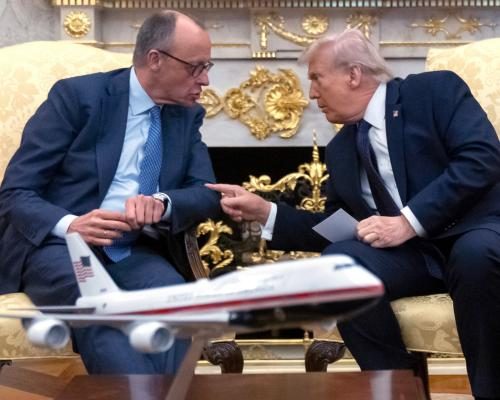
In a provocative statement that could reshape U.S.-Germany relations, former President Donald Trump indicated he is contemplating a reduction of American troops stationed in Germany. This announcement follows German Chancellor Friedrich Merz's scathing critique of U.S. diplomacy regarding Iran, where he characterized the nation as being "humiliated" in negotiations. Trump's comments come hot on the heels of his recent phone call with Russian President Vladimir Putin, raising concerns about shifting geopolitical dynamics.
Trump's remarks about U.S. military presence in Germany were made public after Merz's assertion that the U.S. was suffering international embarrassment due to its approach to Iran. On social media, Trump stated, "We are studying and reviewing the possible reduction of troops in Germany, with a determination to be made over the next short period of time." This statement underscores the growing tensions between the two leaders and highlights the fragile nature of transatlantic alliances. Originally reported by The Guardian.
Merz Criticizes U.S. Policy on Iran
Chancellor Friedrich Merz has been vocal in his criticism of U.S. policies, particularly regarding Iran. He expressed concerns that the ongoing conflict has significant repercussions for Germany's economic standing. At a recent meeting with high school students, Merz stated, "The U.S. is being humiliated by Iran's leadership through negotiations that lead to nothing." He argued that the costs of the war against Iran are straining Germany's economic performance, emphasizing the urgent need for a resolution.
Merz also pointed to the broader implications of the Iranian conflict, stating, "This war against Iran has a direct impact on our economic performance, and for that reason, it must be brought to an end as soon as possible." This criticism appears to have struck a nerve with Trump, who responded sharply, asserting that Merz's views on Iran's nuclear ambitions are misguided. He tweeted, "The Chancellor of Germany, Friedrich Merz, thinks it's OK for Iran to have a Nuclear Weapon. He doesn't know what he's talking about!"
Ukraine's Diplomatic Maneuvers
In the backdrop of these escalating tensions, Ukraine's President Volodymyr Zelenskyy has been proactive in addressing the situation following Trump's phone call with Putin. Zelenskyy took to social media to announce that he had instructed his team to reach out to Trump's aides to clarify details surrounding Russia's proposal for a temporary ceasefire. He stated, "Ukraine seeks peace and is doing the necessary diplomatic work to bring this war to a real end."
His comments are particularly pointed. Zelenskyy questioned whether the proposed ceasefire was merely a tactical maneuver by Russia, possibly designed to ensure security for an upcoming military parade in Moscow. He said, "We will clarify what exactly this is about - a few hours of security for a parade in Moscow, or something more." His remarks highlight Ukraine's ongoing struggle for stability in the face of Russian aggression.
The Impact of Trump's Comments
Trump's threats to reconsider troop deployments in Germany could have serious ramifications for NATO and U.S. foreign policy. The possibility of reduced troop levels adds to the uncertainty surrounding America's commitment to its European allies, especially in light of recent geopolitical developments. Observers note that such a shift could embolden adversaries like Russia and Iran, who may perceive a decrease in U.S. military presence as a sign of weakened resolve.
Moreover, Trump's assertion that he is "doing something with Iran, right now, that other Nations, or Presidents, should have done long ago" suggests a potential pivot in U.S. foreign policy that may not align with the interests of European nations. The fallout from this diplomatic spat could strain U.S.-Germany relations further, particularly if Merz continues to criticize Trump's methods.
As this narrative unfolds, the implications of Trump's comments will be closely monitored across Europe and beyond. The stakes are high, and the dynamics of international relations are rapidly evolving as leaders grapple with these pressing issues.
With diplomatic channels buzzing and tensions simmering, it remains to be seen how Germany will respond to Trump's threats and whether Ukraine's attempts at peace will yield any tangible results. As the situation continues to develop, the international community is left watching closely, hoping for a resolution that promotes stability rather than conflict.
Originally reported by The Guardian. View original.