
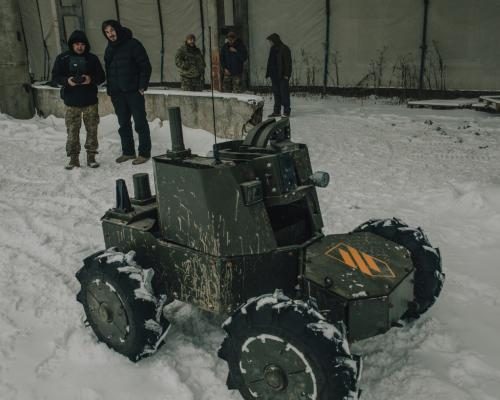
In a striking evolution of modern warfare, Ukraine has introduced a range of battery-powered land robots designed to assist its troops against Russian forces. These unmanned ground vehicles (UGVs) have seen significant deployment since spring 2024, showcasing a new era in military technology. Victor Pavlov, a lieutenant with Ukraine's 3rd army corps, described this innovation as a transformation in combat strategy, stating, \"This is what modern warfare looks like. Armies everywhere will have to robotise.\" The ongoing conflict, now entering its fifth year, has increasingly shifted from traditional armored warfare to a technological contest marked by the use of inexpensive drones and robotic systems.
\n\nRobotic Versatility on the Battlefield
\nThe versatility of Ukraine's UGVs is particularly notable, with designs that include vehicles resembling milk floats on caterpillar tracks, wheeled models equipped with antennas, and even those carrying anti-tank mines. As the war with Russia has intensified, the operational use of these robots has surged, with January 2025 recording a staggering 7,000 operations utilizing these unmanned systems. Pavlov highlighted their role in logistics, pointing out that they now account for 90% of the Ukrainian army's logistical operations. The ability to maneuver through hazardous areas, often under the watch of hostile drones, has made these robotic systems indispensable. Originally reported by The Guardian.
\n\nOne of the most striking features of these robots is their capacity to deliver essential supplies like food and ammunition to frontline troops. They can also evacuate wounded soldiers, with some capable of transporting up to three at a time. Unlike conventional armored vehicles, these robots are smaller and less detectable, giving them an advantage in avoiding Russian surveillance.
\n\nTechnological Advancements and Combat Applications
\nRobots are increasingly equipped with sophisticated weaponry, including remote-controlled machine guns and grenade launchers. One specific model, the DevDroid TW 12.7, successfully defended a position for an impressive 45 days. An account from last summer illustrates the effectiveness of these systems: a kamikaze robot carrying 200 kilograms of explosives traveled 12 miles to destroy a Russian-held school building. Bambi, a drone operator with the 25th airborne brigade, remarked on the unsettling power of these machines, stating, \"It's not Star Wars, where there are lots of lasers. The frontline is more like Terminator. A land robot arrives at your position and there is nothing you can do about it.\"
\n\nAdditionally, these UGVs have essential engineering capabilities. Recent models can mine and de-mine, lay barbed wire, and even tow damaged vehicles off the battlefield. The rapid pace of their deployment is evident, as Pavlov noted his company experiences a loss of about three robots daily due to Russian aerial assaults, representing an attrition rate of 25%. However, he emphasized that this loss is a "small price to pay" for the lives saved among infantry.
\n\nA Revolutionary Shift in Warfare Dynamics
\nThe expansion of robotic systems has fundamentally changed operations for Ukraine's armed forces. Defense Minister Mykhailo Fedorov pointed out that just six months ago, the use of ground robotic systems for casualty evacuation was sporadic. Now, these robots routinely venture into high-risk areas, facilitating logistics and medical evacuations in ways that would pose excessive risk to human personnel.
\n\nRemarkably, the nature of warfare has evolved to the point where Russian soldiers have surrendered to armed ground robots. One incident involved soldiers emerging from a building under fire, only to find themselves facing a robotic unit. The 3rd army corps, known for pioneering unmanned ground systems, executed a successful counter-offensive that underscored the strategic advantages of robotic warfare.
\n\nTraining for these advanced systems is ongoing, with the KillHouse academy in northeastern Ukraine preparing UGV pilots for the challenges of modern combat. Exercises include navigating vehicles over varied terrains and utilizing computer simulations to enhance operational readiness. Instructor Oleksandr, known by the call sign "Barman," oversees this critical training, ensuring that soldiers are equipped to handle the sophisticated technology shaping today's battlefield.
\n\nAs Ukraine continues to innovate within the realm of robotic warfare, the implications for future conflicts are profound. The reliance on unmanned systems not only highlights the changing nature of military engagement but also sets a precedent for how armies may operate in the years to come. With technology becoming an integral component of combat, the landscape of warfare is likely to keep evolving, driven by both necessity and ingenuity.
", "excerpt": "Ukraine's deployment of advanced robotic systems marks a significant shift in modern warfare as it battles Russian forces, showcasing innovative military technology.", "seo_title": "Ukraine's Robotic Warfare: A New Era in Combat", "seo_description": "Explore how Ukraine's advanced robotic systems are transforming warfare against Russia, highlighting innovations in unmanned ground vehicles and military strategy.", "focus_keywords": "Ukraine, robotic warfare, unmanned ground vehicles", "word_count": 700, "keyword_count": 3, "keyword_density": "0.43%" }Originally reported by The Guardian. View original.