
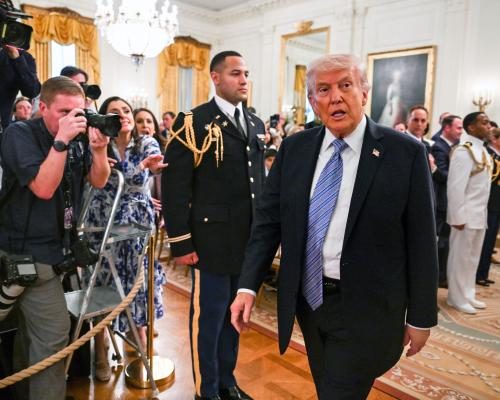
In a significant shift in U.S. military strategy, President Donald Trump announced a pause in efforts to guide ships through the Strait of Hormuz, as tensions with Iran continue to escalate. This decision, made on Tuesday, aims to provide space for negotiations to finalize a settlement with Tehran amid ongoing military operations. Meanwhile, Iranian Foreign Minister Abbas Araghchi is in Beijing for talks with Chinese officials, signaling a complex diplomatic landscape in the region.
Trump's New Approach to Hormuz Operations
President Trump revealed via social media that the initiative to assist vessels navigating the critical Strait of Hormuz is now on hold. In his announcement, he cited the request from Pakistan and other nations as a motivating factor for this pause. "Based on the request of Pakistan and other Countries, the tremendous Military Success that we have had during the Campaign against the Country of Iran and, additionally, the fact that Great Progress has been made toward a Complete and Final Agreement with Representatives of Iran," Trump stated. Despite this pause, he made it clear that the blockade on ships departing Iranian ports would remain intact. Originally reported by The Guardian.
U.S. Secretary of State Marco Rubio supported Trump's decision, claiming that the military objectives of the ongoing operation, dubbed "Operation Epic Fury," have reached their conclusion. He emphasized that the U.S. actions in the Strait of Hormuz are now strictly defensive, suggesting that the U.S. military would refrain from offensive action unless provoked. "There's no shooting unless we're shot at first," Rubio asserted during a press briefing at the White House.
Iran's Diplomatic Engagement with China
In a parallel development, Iranian Foreign Minister Abbas Araghchi met with China's top diplomat, Wang Yi, in Beijing on Wednesday. According to China's Xinhua news agency, the specifics of their discussions were not disclosed, but Araghchi's visit marks a notable moment in Iran's diplomatic efforts amid the ongoing conflict. The Iranian Fars news agency reported that Araghchi aimed to discuss bilateral relations and broader regional and international developments with his Chinese counterpart.
China plays a crucial role in Iran's economy, typically importing over 80% of its oil from the Islamic Republic, which represents about 12% of China's total oil supply. This relationship provides Iran with a significant avenue for economic support, particularly as it faces growing pressure from the United States and its allies.
Increased Military Activity in the Region
Amid these diplomatic maneuvers, military tensions in the region have escalated. The United Kingdom's maritime authority reported that a cargo vessel was struck by an unknown projectile in the strategically vital Strait of Hormuz. This incident follows previous reports from the United Arab Emirates, which claimed its air defenses intercepted multiple missiles and drones launched from Iran. The UAE's defense ministry reported that it had successfully shot down 15 Iranian missiles and four drones in recent days, highlighting the precarious security situation in the region.
These developments come against a backdrop of heightened military engagement, with Trump's administration asserting that its operations aim to protect maritime interests. Rubio emphasized that the U.S. is working to reopen the Strait of Hormuz, framing the initiative as a humanitarian effort. However, critics argue that the U.S. military presence has contributed to the instability in the region, leaving thousands of mariners stranded in the waterway.
Future Implications of the Ceasefire
As the ceasefire hangs in the balance, Trump refrained from specifying what actions would constitute a violation of the agreement, stating, "Iran knows what not to do." His ambiguous stance reflects the complex dynamics at play, as both sides continue to navigate a fraught military and diplomatic landscape. The U.S. has maintained its position of readiness, asserting its right to defend its interests in the region.
This ongoing situation underscores the delicate balance of power in the Middle East, as diplomatic efforts clash with military realities. As Araghchi engages with Chinese leaders, the international community watches closely, hoping for a resolution that addresses the underlying tensions. The pause in U.S. operations may provide a temporary reprieve, but the potential for conflict remains high as both nations remain at an impasse.
Originally reported by The Guardian. View original.