
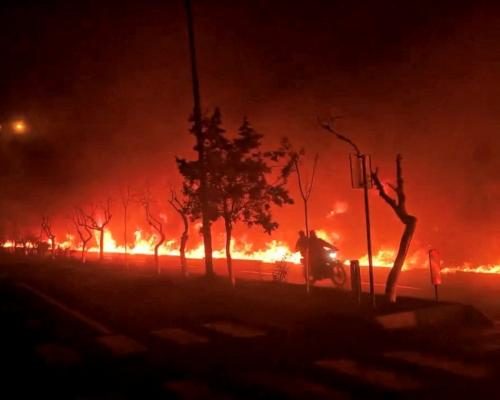
Residents of Tehran have reported experiencing the most severe night of aerial strikes in recent memory, with explosions echoing throughout the city. This escalation follows mixed messages from US officials regarding the potential duration of the ongoing conflict in the region. Reports indicate that at least 1,245 civilians, including 194 children, have lost their lives amid the US-Israeli military campaign against Iran, as the hostilities show no signs of abating.
Severe Aerial Assaults in Tehran
On Tuesday morning, Tehran residents described a harrowing night filled with relentless explosions. Niloufar, a local resident who chose to use a pseudonym for safety reasons, recounted, "We are under heavy bombardment and I can hear back-to-back explosions. The place they hit has caught fire. It's not clear where it exploded, but the buildings are shaking." Eyewitnesses noted that low-flying jets were active above the capital, intensifying fears among the population. The air campaign, which began on February 28, has reportedly targeted various facilities, including a weapons development site. Originally reported by The Guardian.
With rolling blackouts reported across the city, many residents expressed concern over their safety and the growing chaos. The World Health Organization has urged residents to remain indoors due to fears of respiratory issues caused by "black rain" following strikes on oil facilities. Another Tehran resident described the situation as "the last stop before hell," illustrating the dire conditions faced by the citizens.
Contradictory US Messages on War Duration
As tension Escalates in the region, US officials have sent mixed signals regarding the conflict's future. During a call with CBS News, former President Donald Trump claimed that "the war is very complete." However, US Defense Secretary Pete Hegseth contradicted this assertion, stating that the war would end on "our timeline" and vowing that the military operations would continue until Iran was "totally and decisively defeated." He warned that the strikes on Tehran would reach unprecedented intensity, further complicating the situation.
General Dan Caine, Chair of the US Joint Chiefs of Staff, confirmed that US forces have targeted over 5,000 sites in Iran, with a focus on degrading its military capabilities. This includes a concerted effort to weaken Iran's ballistic missile and drone assets and reopen the Strait of Hormuz, a crucial maritime passage for global oil trade. As military operations intensify, the rhetoric from both sides has become increasingly hostile.
Iran's Response and Regional Implications
In the face of ongoing military action, Iranian officials have asserted they will not accept a cessation of hostilities until a significant cost is inflicted on the US and its allies. Ali Larijani, head of Iran's National Security Council, declared that the "nation of Iran does not fear your empty threats," implying that retaliation could extend to high-profile targets, including Trump himself. This threat comes in reaction to Trump's warning that Iran could face strikes "20 times harder" should it disrupt oil flow through the Strait of Hormuz.
The ripple effects of this conflict are already being felt globally. Oil prices have surged, causing concern among consumers and investors alike. Economists warn that continued disruptions to Gulf oil production could trigger an energy crisis reminiscent of the 1970s, impacting economies worldwide. Iran has not limited its retaliation to US interests; it has also targeted Gulf allies, resulting in civilian casualties and damage in countries like Bahrain and the UAE.
Life Amid Conflict in the Gulf
Despite the escalating violence, life in some parts of the Gulf region continues with a semblance of normalcy. In Dubai, for instance, residents flock to beaches and shopping malls, with many tourists initially fleeing now returning as commercial flights resume. Nader Farid, a 30-year-old expatriate from Egypt, expressed, "They say it's a war but it's caused no problem for us, we don't really see it at all." This sentiment contrasts sharply with the experiences of those in Tehran, highlighting the stark differences in how the conflict is perceived and felt across the region.
As the situation develops, the ongoing airstrikes and mixed messages from US officials raise questions about the future of the conflict and its broader implications for regional stability. The harsh realities faced by civilians, both in Iran and in neighboring states, underscore the urgent need for diplomatic solutions.
Originally reported by The Guardian. View original.