
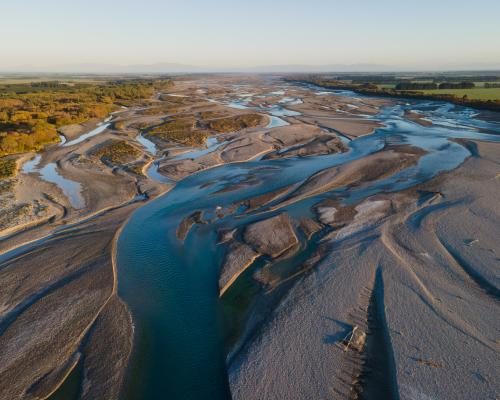
As New Zealand grapples with the management of its unique braided rivers, the Waimakariri River stands at the forefront of a complex debate. With a history of flooding and ecological disruption, authorities are now faced with the challenge of balancing human development and environmental preservation in the South Island's Canterbury region.
Historic Neglect and Modern Challenges
When British settlers established Christchurch 170 years ago, they largely overlooked the nearby Waimakariri River, which winds from the Southern Alps to the eastern coast. Over time, natural events like heavy rainfall and glacial movements altered the river's course, leading to flooding and the deposition of massive amounts of shingle. By the 1920s, the river was labeled a "flood menace" in a governmental report, highlighting a perceived "deficiency of nature, which must be made good by the art of man." This led to extensive modifications, including the construction of stopbanks, exotic tree planting, and gravel extraction-interventions that now require constant maintenance to protect homes, infrastructure, and even the nearby airport from flooding. Originally reported by The Guardian.
"People say you shouldn't be interfering with the river; the outcome if we don't is worse," explains Fred Brooks, a river engineer with Environment Canterbury. "It has been intervened in so much at this point, you have to keep intervening." The Waimakariri is one of approximately 150 braided rivers in New Zealand, with 60% located in Canterbury, a region known for its fragile ecological systems.
The Unique Dynamics of Braided Rivers
Unlike single-channel rivers, braided rivers are inherently dynamic, originating in alpine ranges and rushing towards the plains. They carry gravel and create multiple channels that split and weave into intricate patterns. However, these rivers have become increasingly constrained due to human activity, including farming and urban development. In the case of the Waimakariri, gravel extraction has become a daily operation to prevent flooding, with heavy machinery working to maintain the stopbanks that protect surrounding areas.
"It's not an easy question to answer," says Jo Hoyle, a river geomorphologist at Earth Sciences New Zealand. "How much room do these rivers actually need to be a river, to support ecological life and have enough room to flood without causing too much damage?" The narrowing of rivers has serious implications, as studies indicate that nine of Canterbury's rivers have shrunk by an average of 50%, with some segments experiencing over a 90% reduction in width. This encroachment poses risks not only to the rivers themselves but also to the surrounding communities.
Impacts on Biodiversity and Local Communities
Compounding the issue, local communities are witnessing declining fish populations and increased pollution in braided rivers. The Rakaia River, known for its salmon fishing, has seen a notable drop in salmon numbers, leading to drastic measures such as banning fishing during the annual competition. Chris Agnew, president of the fishing competition, expressed concern, stating, "There are less and less fish." According to Fish & Game, only 608 salmon were counted in the Rakaia this year, a stark contrast to previous seasons.
As ecological health deteriorates, the question of managed retreat also arises. The land adjacent to braided rivers can be highly valuable yet remains vulnerable to flooding. Hoyle suggests that while landowners have the legal right to occupy riverbeds when the water recedes, this practice exacerbates the problem, forcing rivers into narrower channels. "Deliberate narrowing is a problem for species, and it is setting people up for disaster from flooding," she adds.
Seeking a Sustainable Solution
The future of braided rivers in New Zealand hangs in the balance. With growing concerns over ecological degradation and flood risks, the conversation has shifted towards sustainable solutions that can accommodate both human needs and environmental health. Experts are advocating for a more balanced approach-one that allows rivers to maintain their natural flow while implementing protective measures for communities.
As New Zealand faces climate change and increasing weather extremes, the need for a comprehensive understanding of braided river systems becomes ever clearer. "Braided rivers are iconic-we use their iconography all over the place," Hoyle notes. "And yet, are we really looking after them?" The answer remains uncertain, but it's clear that a collaborative effort is required to protect these unique ecosystems.
Originally reported by The Guardian. View original.