
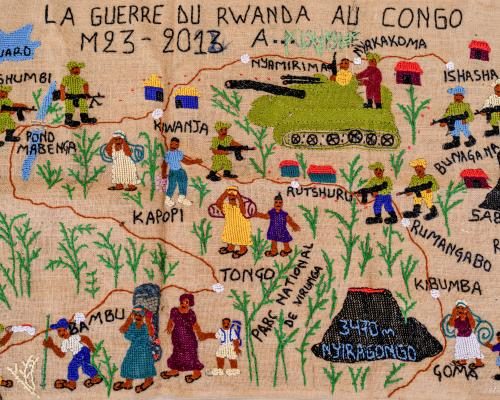
In Goma, eastern Democratic Republic of the Congo, Lucie Kamusekera, 82, is stitching her country's history onto tobacco sacks. Her collection exceeds 70 works, preserving decades of violence even as the rebel offensive that captured her city in early 2025 threatens what she can safely depict.
From convent sewing to Congo's historical archive
Born in 1944 in Lubero, a mountainous part of North Kivu province, Kamusekera learned sewing from Italian nuns at her convent school. "I wanted to get good to inspire the other students," Lucie Kamusekera says. "I started by designing flowers and little gifts for my neighbours." Originally reported by The Guardian.
Now she makes needles from scrap metal and obtains sacks from tobacco factories. Working in bright primary colours, she records events ranging from colonial exploitation to fighting documented in North Kivu in November 2023.
Her works show forced labour and the brutality of the Force Publique, the Belgian Congo's military enforcers. They also depict the 1961 murder of Patrice Lumumba, the independent DRC's first prime minister, assassinated in a plot led by Belgian officers with support from the CIA and British intelligence.
Another subject is the second Congo war, which left an estimated 5 million civilians dead between 1998 and 2003. For Kamusekera, these aren't distant episodes to illustrate. They're part of the upheaval that uprooted her family and made embroidery a means of keeping a record.
Her embroidered histories turn discarded commercial fabric into an archive of events that have shaped generations of Congolese lives.
A husband's death behind the embroidered histories
After marrying a trader, Kamusekera moved to his village of Kibirizi. They had five children, but repeated conflict eventually drove them to Goma more than 20 years ago. She can't remember which battle finally forced their departure.
There, seeing a military truck carrying bodies changed her work. "It was not full of men, but full of corpses and blood. I knew then that I had to record these stories of my country," Lucie Kamusekera recalls.
Her studio occupies a small shopfront in Kyeshero, beside the family's home, a shack of uneven wooden planks. Outside, volcanic rock speckles the dusty road black and grey.
In the early 2000s, disrupted food deliveries prompted her husband to return to Kibirizi for their remaining crops. An armed gang from Laurent Nkunda's CNDP rebel group seized him.
"They mocked him by forcing him to set his own house alight, then tortured him and beat him," Lucie Kamusekera says. He returned injured and died in hospital within a month. The CNDP preceded M23, which seized Goma in 2025.
The family's flight reflects the experience of millions of Congolese displaced by wars, their lives repeatedly disrupted by armed groups.
M23 occupation narrows what she can stitch
Backed by neighbouring Rwanda's army, M23 began its campaign in late 2021. Hundreds of civilians were killed during Goma's siege in January 2025. More than a year later, occupied areas face hardship and economic crisis.
Kamusekera hid at home as artillery sounded and fleeing soldiers entered her avenue. "I have no idea how I am still alive," Lucie Kamusekera says. "I get tears in my eyes thinking about what happened."
Her subjects include M23 leaders Sultani Makenga and Corneille Nangaa, and spokesperson Willy Ngoma, killed in February. But occupation has imposed limits.
"I have drawn some dangerous stories in my time, but there are some realities I cannot publish works about because I would fear for my life," Lucie Kamusekera says.
Family members now help her work and supply information from across the country. Her great-granddaughter, Divine Kyetia, annotates drafts and negotiates with clients. "They need to know my style; I may die tomorrow, and I would like them to continue," Lucie Kamusekera says.
That leaves her balancing two responsibilities: documenting the violence around her and protecting the relatives who help keep her studio and its historical record alive.
Despite the restrictions, she won't leave Goma. "I imagine a world in which social media and the internet are gone," Lucie Kamusekera says, "but the stories will remain on the tapestries and can be shared." Her hope is that younger relatives will carry the work forward, preserving an account of Congo's suffering that outlasts both conflict and technology.
Originally reported by The Guardian. View original.