
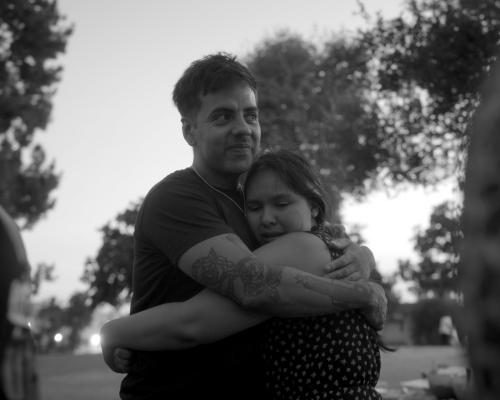
As dusk settled over Mexico City's Escandón neighborhood, Abel Ortiz found himself caught in a moment that stirred deep emotions. Two American women were shouting at each other on the street, their voices sharp and accusatory. "I can't believe you called my fucking mom!" one yelled, while the other retorted, "You should go back home!" Ortiz felt an overwhelming urge to intervene, to tell them that they were in his country. This moment was jarring, especially for a man who had spent nearly his entire life in the United States.
Born in Mexico, Ortiz was taken to the U.S. as an infant, seeking a better life. For 38 years, he lived in Los Angeles, building a life that revolved around his thriving hair salon business, his best friend, and a community that he had nurtured for decades. However, the political climate shifted dramatically with the rise of Donald Trump, who labeled undocumented immigrants like Ortiz as public enemies. This shift instilled fear and uncertainty, prompting Ortiz to make a life-altering decision last August. He packed two bags with clothes and cherished photographs, becoming yet another statistic in the harsh campaign against those labeled as "illegal aliens." Originally reported by The Guardian.
Leaving America Behind
On August 4, 2025, Ortiz decided enough was enough. The palpable presence of national guard troops and unmarked ICE vehicles in Los Angeles made him increasingly uneasy. Fearing the repercussions of flying out of LAX, he chose to cross the border overland to Tijuana. Accompanying him were filmmakers Isabel Castro and Jamie Gonçalves, who lived nearby and were keen to document his poignant departure. As Ortiz drove through familiar streets for the last time, he expressed disbelief that he might never see these places again. The short film captures his emotional farewell and ends with his arrival in Mexico City.
Seven months later, Ortiz is still navigating the complexities of his new life as a self-deportee. Initially, he was overwhelmed by a newfound sense of freedom. With his Mexican passport in hand, he could travel to beach towns like Puerto Escondido and Puerto Vallarta without the constant fear of deportation. Unlike in Los Angeles, where he always felt like an outsider, Ortiz discovered a community where he blended in with people who shared his features. "A part of my identity had been filled in. I feel lighter," he shared, reflecting on the relief of not having to question his belonging.
Struggles of Identity and Belonging
Yet, this liberation comes with its own set of challenges. Ortiz experiences a profound sense of disorientation and sadness. He grapples with existential questions about his identity, often finding himself asking, "Who am I? What do I want? How do I live, when I'm neither here nor there?" The reality of leaving behind a successful business and a tight-knit community weighs heavily on him. The vibrant culture of Mexico City is a welcome change, but it cannot erase the pain of what he has lost.
In his spacious apartment in Escandón, Ortiz recalls his childhood in Mexico. Growing up in poverty with nine siblings, he understands the sacrifices his father made when they immigrated to the U.S. in search of a better future. The clandestine journey across the border was fraught with danger; Ortiz nearly died from dehydration as a baby when they arrived in Los Angeles. As a teenager, he faced his own struggles, including a felony conviction that barred him from DACA eligibility. All these experiences culminated in his decision to leave America, a place he once called home.
A New Chapter in Mexico City
Despite the challenges, Ortiz has found solace in Mexico City's vibrant culture and communities. He is learning to navigate life in a country he hardly remembers, often feeling a mix of liberation and loss. The past few months have been a journey of self-discovery, as he wrestles with the memories of his former life and the reality of his new one. Even as he embraces this new chapter, Ortiz acknowledges the emotional toll of his experience.
"I've done the hardest thing I ever could," he admits, reflecting on the duality of his existence. The pain of leaving everything behind is real, but so is the joy of reclaiming a part of his identity. As Ortiz continues to adapt, he remains hopeful about the future, navigating the complexities of his new life with resilience and determination.
Originally reported by The Guardian. View original.