
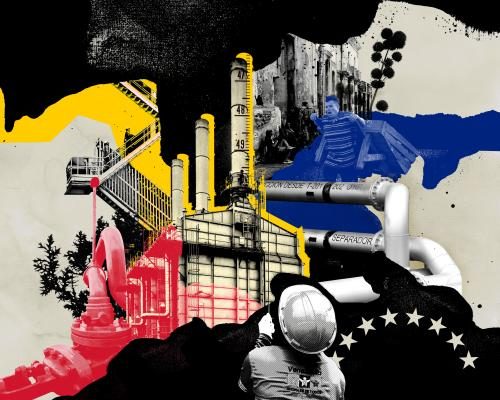
In western Venezuela, the Campo Boscán oil complex stands as a testament to both resilience and decay. Drilling rigs, pumps, and pipelines extract crude oil in an environment marked by broken roads, rampant weeds, and security measures to prevent theft. Albenis Merchán, a seasoned drilling technician with 35 years of experience, recalls the heyday of the region as he navigates his pickup through the desolate landscape. "We used to receive maintenance and safety training all the time. Supplies and spare parts were never lacking. Many things need to improve here to tap the full potential of this area," he states.
Located 40 kilometers from Maracaibo, the capital of Zulia state, Campo Boscán has been a cornerstone of Venezuela's oil production since its discovery in 1945 by the Richmond Exploration Company. Even today, it continues to produce over 100,000 barrels of oil daily, contributing to the country's overall output of approximately one million barrels. Despite the neglect, this field is considered a privileged asset in a nation that has seen most of its foreign investment flee since the nationalization of the energy sector under the late President Hugo Chávez in 2006. Originally reported by The Guardian.
Chevron's Strategic Role in Reviving Production
Chevron remains one of the few major foreign companies still operating in Venezuela, having formed a joint venture with the state-run oil company PDVSA called Petroboscán. Under this arrangement, Chevron holds a 40% stake while PDVSA retains 60%. This partnership has been viewed as a potential precursor to an improved commercial relationship between the U.S. and Venezuela, particularly in light of U.S. political developments.
The Trump administration's efforts to engage with Venezuela have sparked renewed interest from other energy companies. During a recent meeting with executives from major energy firms, Chevron's vice chairman, Mark Nelson, projected that the company could boost its output in Venezuela by as much as 50% within 18 to 24 months. However, skepticism lingers among industry leaders, who remain wary of investing heavily in a nation plagued by political instability and regulatory uncertainty.
Legal Reforms Paving the Way for Investment
In an effort to revitalize the oil sector, the Venezuelan government, led by interim president Delcy Rodríguez, is pushing for urgent reforms to the hydrocarbons law. This legislation, which nationalized the industry two decades ago, is aimed at facilitating oil production and exports with significantly less state involvement. The changes are a response to the historical crisis that followed Chávez's nationalization, which led to the loss of hundreds of companies and thousands of jobs.
In mid-February, Chris Wright, the U.S. energy secretary, visited a Chevron-operated field in eastern Venezuela, marking an unprecedented alliance that could reshape the dynamics of the industry. The Trump administration has projected that around $100 billion will be necessary to restore the country's oil production capacity. Experts like Francisco Monaldi, who directs the Latin America energy program at Rice University, highlight the urgent need to address Venezuela's crumbling electricity infrastructure, which has been plagued by frequent blackouts due to years of underinvestment.
The Need for Skilled Workers in the Oil Sector
Venezuela faces another significant challenge: the need for skilled labor. After a mass exodus of professionals, particularly following a general strike in 2003 when Chávez dismissed 20,000 PDVSA workers, the country is now grappling with a shortage of experienced personnel. The University of Zulia, once a premier institution for engineering graduates, now sees empty halls and a dwindling student body.
Despite the ongoing brain drain, Monaldi believes that many of the future professionals in the oil sector will be Venezuelan. He notes that foreign companies are already identifying local talent, with many of them having families in the country, thus easing their transition back. Merchán highlights the urgency of this situation, stating, "Young engineers who arrive don't know anything, and they don't want to learn either," underscoring the critical need for mentorship and training.
With the prospect of a new oil boom on the horizon, Venezuelans remain hopeful. The potential recovery of the sector could signify not just economic revitalization but also the chance to reclaim a vital part of the nation's identity. The drive for investment, infrastructure improvement, and skilled labor development will be crucial in determining whether Venezuela can once again become a major player in the global oil market.
Originally reported by The Guardian. View original.