
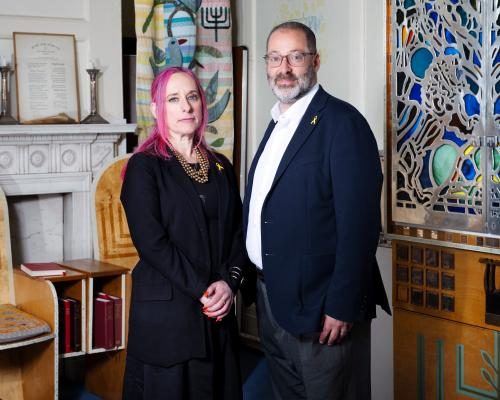
The United Kingdom's leading progressive rabbis have issued a stark warning that Israel's current political trajectory poses a significant risk to Jewish values, suggesting it could lead to an "existential threat" not only to the nation itself but to the essence of Judaism. Rabbi Charley Baginsky and Rabbi Josh Levy, co-leaders of the newly formed Progressive Judaism movement-which represents approximately one-third of synagogues across the UK-emphasized the importance of critiquing Israel's government as a vital part of Jewish identity, rather than an act of disloyalty.
Concerns Over Israel's Political Direction
Rabbi Baginsky articulated her concerns, stating, "We've often talked about the direction of Israel being an existential threat not to Jews per se, but to Judaism." She highlighted the potential conflict between Israel's governmental actions and the core values that many Jews hold dear. The fears and questions raised by the rabbis underscore the complexities facing the Jewish community as they navigate their relationship with Israel amidst a shifting political landscape. Originally reported by The Guardian.
In a significant move, they are launching their first book, titled Progressive Judaism, Zionism and the State of Israel, which compiles 40 essays from Jewish clergy and community leaders. This work aims to shed light on the ongoing debates surrounding Jewish identity, the nature of Zionism, and the state of Israel. Rabbi Levy emphasized the necessity of exploring these challenging issues, asserting that doing so is essential for a mature conversation about Jewish values and the community's responsibilities.
A Diverse Collection of Perspectives
The collection of essays presents a rich tapestry of viewpoints, including contributions from those who do not identify as Zionists, showcasing the breadth of opinions within the Jewish community. Rabbi Levy pointed out that the diversity of voices should be seen as a strength rather than a weakness. "One of the things that we have seen in the world by the Jewish community is the view that diversity of voice is somehow weakening," he noted. This highlights the movement's commitment to fostering dialogue and understanding, even if it means confronting uncomfortable truths.
Baginsky and Levy are determined to maintain a space where differing opinions can coexist, stating that there are no political or theological requirements to participate in their communities. This open approach not only welcomes varying perspectives but also encourages a critical examination of the relationship between Judaism and Israel. They believe it is crucial to examine how the actions of the Israeli government reflect upon Jews worldwide and influence their identity.
Religious Zionism Reimagined
Both rabbis have expressed their desire to redefine what religious Zionism means, distancing themselves from the far-right narratives often projected by Israeli politicians such as Bezalel Smotrich and Itamar Ben-Gvir. Rabbi Baginsky shared her commitment to a more inclusive vision of Zionism, stating, "We have a responsibility to show that our religious Zionism is not the religious Zionism that we see sometimes coming out of the West Bank." This perspective acknowledges the rights of Palestinians and advocates for a nuanced understanding of Zionism that encompasses justice and equality.
Rabbi Levy reinforced this view by stating, "It's not that kind of proprietorial Zionism. It's a different kind of Zionism that's articulated out of our religious life. It's textual, it's deep, and it's rich." This reimagining of Zionism is crucial for fostering a Jewish identity that is responsive to contemporary moral challenges and supports a just resolution to the Israeli-Palestinian conflict.
Facing Criticism and Building Support
Despite facing criticism within some segments of the British Jewish community, particularly after their remarks at a rally for Israeli hostages held by Hamas, both rabbis remain steadfast in their pursuit of peace and justice. They were met with heckling when they called for an end to the conflict and advocated for the establishment of a Palestinian state. Rabbi Baginsky reflected on that moment, stating, "That moment was painful. It was nearly a year ago, and I still feel it viscerally." However, she also highlighted the outpouring of support from various sectors of the Jewish and wider faith community in the aftermath.
This ongoing dialogue is vital as the Progressive Judaism movement seeks to navigate its path forward. The hope remains that by embracing complexity, engaging in critical discussions, and fostering inclusivity, the movement can contribute positively to the evolving narrative of Judaism and its relationship with Israel.
Originally reported by The Guardian. View original.