
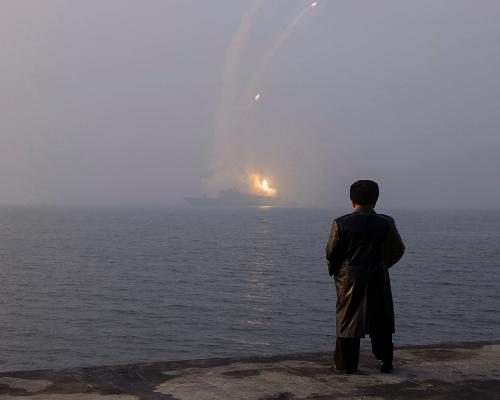
North Korea's recent missile launch from a naval destroyer highlights a significant shift in its military strategy, as Kim Jong-un declares progress in arming ships with nuclear capabilities. This development coincides with heightened tensions in the Middle East, particularly as the U.S. and Israel intensify their military actions against Iran, a nation Donald Trump warned could soon acquire nuclear weapons. Kim's remarks, made during a time of escalating international conflict, send a clear message about North Korea's commitment to strengthening its nuclear arsenal as a means of ensuring regime survival.
Kim Jong-un's Calculated Messaging
The launch of the missile from the Choe Hyon, North Korea's largest destroyer-class warship, serves as more than just a display of military prowess. Kim Jong-un's statement regarding the "satisfactory progress" in nuclear armament is a calculated move to project strength both domestically and internationally. As the U.S. and Israel conduct airstrikes in Iran, Kim likely perceives these actions as a warning that nuclear capability is essential for national security. Song Seong-jong, a defense expert at Daejeon University, noted that Kim may believe Iran was targeted precisely because it lacked nuclear weapons, reinforcing North Korea's determination to advance its own capabilities. Originally reported by The Guardian.
The Implications of Military Action in Iran
The ongoing conflict in the Middle East has profound implications for North Korea's nuclear strategy. As the Iranian regime faces an existential threat, Kim's regime is likely interpreting these events as validation of its own nuclear ambitions. North Korea has been pursuing a nuclear arsenal for years, with its first test occurring in 2006 and the most recent in 2017. Despite international sanctions and diplomatic efforts led by Trump to denuclearize the Korean Peninsula, North Korea has made it clear that its nuclear program is integral to its national defense strategy.
According to a report from the Stockholm International Peace Research Institute, North Korea currently possesses approximately 50 nuclear warheads and has the capacity to produce an additional 40. This stockpile underscores Kim's focus on nuclear deterrence as a means of ensuring the survival of his regime, especially in light of recent global events that have showcased the vulnerabilities of non-nuclear states.
North Korea's Diplomatic Calculus
In response to the conflict in Iran, North Korea's foreign ministry condemned the U.S. and Israeli airstrikes as an "illegal act of aggression," characterizing them as revealing Washington's "hegemonic and rogue" tendencies. However, Kim's regime has avoided directly condemning Trump, leaving open the possibility for renewed diplomatic engagement. The North Korean leader has expressed a willingness to engage in talks, provided the U.S. acknowledges its nuclear status and drops demands for denuclearization.
Kim was quoted by the Korean Central News Agency (KCNA) as stating, "If the United States withdraws its policy of confrontation with North Korea by respecting our country's current status.. there is no reason why we cannot get along well with the U.S." This is indicative of a nuanced approach, suggesting that while North Korea is resolute in its nuclear ambitions, it is also open to dialogue if its sovereignty and security are respected.
Future Prospects for Diplomacy
The question now remains whether the current geopolitical climate will facilitate or hinder potential negotiations between North Korea and the United States. Some analysts, like Sydney Seiler of the Center for Strategic and International Studies, argue that the ongoing crisis in Iran could make a nuclear deal less likely. Seiler suggests that Trump's aggressive military posturing may make Kim less inclined to engage in talks, fearing that such diplomacy could lead to further U.S. aggression.
Conversely, other experts believe that Kim's desire for regime security and his reportedly personal rapport with Trump could create openings for dialogue. Cho Han-bum, from the Korea Institute for National Unification, noted, "Unlike Iran, it's impossible to denuclearize North Korea," implying that North Korea's nuclear capabilities could provide Kim with leverage in negotiations.
As Trump prepares for a visit to China later this month, speculation about a potential meeting with Kim is mounting. If such talks occur, they could take place under the backdrop of North Korea's strengthened nuclear position, which Kim could leverage for concessions, including security assurances from the U.S.
In the current global landscape, the lesson seems clear: possessing nuclear weapons may increasingly be viewed as a viable path to security, as evidenced by the contrasting fates of nations with and without such capabilities.
Originally reported by The Guardian. View original.