
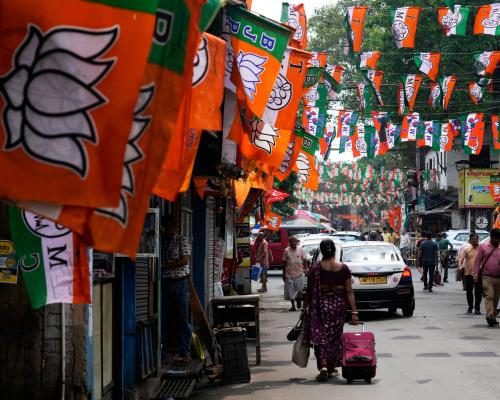
As West Bengal prepares for crucial state elections this week, a staggering 9.1 million voters have been removed from the electoral rolls, igniting fierce criticism across the political spectrum. This unprecedented action, part of a government initiative labeled as a "Special Intensive Revision" (SIR), has raised serious concerns regarding the integrity of the electoral process, particularly among minority communities.
The deletions represent over 10% of the state's electorate. While authorities assert that many of those removed were deceased or duplicates, approximately 2.7 million individuals have contested their removal, only to find their names stripped from the voter rolls nonetheless. Critics, including members of the Trinamool Congress (TMC), have denounced the revision as a "bloodless political genocide," aimed at disenfranchising minorities, particularly Muslims. Originally reported by The Guardian.
Government Justification and Controversy
The Bharatiya Janata Party (BJP), led by Prime Minister Narendra Modi, has justified the rapid revision of the electoral rolls as a necessary step to eliminate what they term "infiltrators," a derogatory reference primarily directed at Muslim migrants from Bangladesh. Home Minister Amit Shah has described this effort as a means to "purify" the electoral roll, a characterization that has drawn sharp rebuke from political opponents.
"What has happened in Bengal is a constitutional crime. It is a crime against the people of India, against the people of Bengal," stated Sagarika Ghosh, a TMC MP. She characterized the deletions as a scandal that would be remembered in the annals of post-independence India. The speed of the SIR process has raised eyebrows, particularly given the upcoming elections scheduled to commence on Thursday, as the BJP seeks to unseat the TMC, which has governed the state for 15 years.
Disproportionate Impact on Minorities
Experts and advocacy groups have highlighted that the revisions have had a disproportionate effect on Muslims and other minority communities in West Bengal. Sabir Ahamed, who leads the Sabar Institute, has noted that religion has emerged as a crucial factor in determining who remains on the voter rolls. "As per our research, religion has been the biggest differentiator," Ahamed remarked, emphasizing that Muslims have been particularly hard-hit by the deletions.
In some areas, such as Muslim-majority constituencies, nearly half of registered voters have been removed from the rolls. This has left many long-time citizens, some with documentation proving their Indian lineage, feeling vulnerable and targeted. Jaber Ali, a 36-year-old village official from Murshidabad district, expressed his dismay after discovering that his own name, along with those he had verified, was removed from the rolls. "People feel they are being targeted and stripped of their voting rights," he lamented.
Legal Challenges and Electoral Integrity
The TMC and various civil rights organizations have challenged the SIR process in court, arguing that it violates constitutional rights and undermines the democratic fabric of the nation. Political analysts assert that the election commission, which oversees the revision, can no longer be seen as an impartial entity.
Former Chief Election Commissioner SY Quraishi has voiced grave concerns about the SIR's implementation across various states, describing it as unnecessary and administratively flawed. "The SIR is completely unnecessary, it is designed to harass. Administratively it is a disaster and the intentions are not noble," he stated. Quraishi questioned the motives behind the rapid push for accuracy in the voter rolls, pointing out that achieving a high level of accuracy typically requires extensive time and effort.
Additionally, the election commission's use of an AI-assisted algorithm to flag so-called "logical discrepancies" has raised eyebrows, leading critics to wonder whether the technology is being utilized to further disenfranchise voters.
As West Bengal gears up for its elections, the ramifications of this mass voter roll revision remain uncertain. With millions stripped of their voting rights and widespread accusations of targeting minorities, the integrity of the electoral process is under intense scrutiny. The outcome of the elections could very well hinge on how these issues play out in the days leading up to the polls.
Originally reported by The Guardian. View original.