
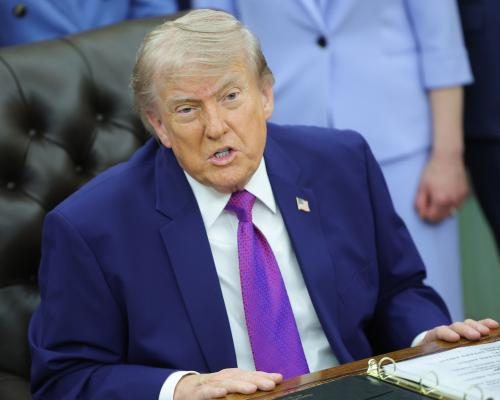
In the ongoing Middle East crisis, former President Donald Trump stated that the ceasefire is "on massive life support" as tensions escalate between the United States and Iran. During a meeting with his national security team on Monday, Trump discussed potential military action against Iran following the nation's rejection of a U.S. peace proposal. This stark declaration underscores the fragile state of the current ceasefire, which Trump described as having a mere 1% chance of survival.
Trump's Rejection of Iran's Peace Proposal
Earlier today, Trump labeled Iran's response to the U.S. peace plan as a "stupid proposal" and "a piece of garbage". He criticized Tehran for failing to uphold an agreement that would allow the U.S. to remove its enriched uranium supply. Despite his condemnation, Trump maintained that a diplomatic resolution remains "very possible". He outlined his belief that his "best plan ever" is straightforward: "Iran cannot have a nuclear weapon and they won't have a nuclear weapon". This firm stance comes as the Iranian government dismissed the U.S. proposal as tantamount to surrendering to Trump's excessive demands, further complicating the situation. Originally reported by The Guardian.
Military Options on the Table
According to reports from Axios, Trump's national security meeting included key officials such as Vice President JD Vance, Secretary of State Marco Rubio, and Secretary of Defense Pete Hegseth. Discussions are centered around the potential resumption of military action against Iran to intensify pressure on its regime and push for concessions on nuclear issues. "He will tune them up a bit," one U.S. official commented, hinting at a more aggressive stance from the Trump administration. Another official noted, "I think we all know where this is going," suggesting a growing consensus towards military involvement.
International Reactions and Regional Impacts
As the U.S. navigates its complex relationship with Iran, the geopolitical landscape continues to shift. In a related development, the UK and France are set to host a multinational meeting of defense ministers aimed at restoring trade flows through the Strait of Hormuz. This meeting, which will involve 40 countries, comes after Iran threatened to target British and French warships if they attempted to intervene in the strategic waterway. The EU has also enacted Sanctions Against Israeli settlers, with Foreign Policy Chief Kaja Kallas stating that "extremisms and violence carry consequences". In response, Israel condemned these actions as politically motivated.
Human Cost of the Ongoing Conflict
The human toll of the conflict has been staggering. The Lebanese health ministry reported that 2,869 people have died due to Israeli airstrikes since the conflict escalated on March 2, with many victims being women and children. Additionally, over 8,730 individuals have sustained injuries. Amid this turmoil, two Israeli soldiers were sentenced to military prison after being photographed desecrating a Christian statue in southern Lebanon, an act condemned by many as deeply offensive.
Moreover, Iran executed a postgraduate student on charges of espionage, alleging collaboration with the CIA and Mossad. Erfan Shakourzadeh, 29, was a student at Iran University of Science and Technology. Reports indicate he denied the charges, claiming they were fabricated. Such incidents highlight the desperate and volatile situation in the region as both sides grapple with escalating hostilities.
The fallout from Trump's rejection of Iran's peace response has already impacted global markets, with Brent crude oil prices rising by as much as 4% to $105.50 per barrel on Monday before settling down slightly. This fluctuation illustrates the broader economic implications of the ongoing conflict, as markets react to geopolitical tensions. As more than 1.2 million people in southern Lebanon have been displaced due to the violence, the urgency for a peaceful resolution to the conflict has never been more pressing.
Looking ahead, Trump remains optimistic about achieving a peace deal with Iran's current leadership. He remarked, "You have the moderates, you have the lunatics. And I think the moderates are more respected. The lunatics want to fight till the end." The complexity of the situation continues to evolve, and the international community watches closely as developments unfold.
Originally reported by The Guardian. View original.