
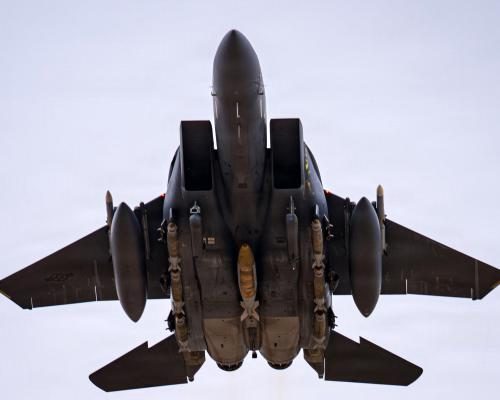
In a dramatic escalation of the ongoing conflict in the Middle East, U.S. and Iranian forces are racing against each other to recover a crew member from a downed U.S. F-15 fighter jet. This incident marks the first confirmed downing of an American warplane within Iranian territory since the start of hostilities. Reports indicate that Tehran claims responsibility for the jet's downing, while U.S. media outlets state that American special forces have successfully rescued one of the two crew members, leaving the other still unaccounted for.
As tensions rise, Iranian state television aired footage purportedly showing the wreckage of the F-15, urging residents in Iran's rugged southwestern regions to assist in the search for the missing pilot. Meanwhile, the Iranian military has announced that it also brought down a U.S. A-10 ground attack aircraft in the Gulf, with reports indicating that its pilot was rescued. U.S. Central Command has not commented on the loss of the F-15, but President Donald Trump confirmed that he has been briefed on the incident. Originally reported by The Guardian.
Escalating Military Operations in the Region
Simultaneously, Israel has intensified its military operations, launching a series of airstrikes in both Tehran and Beirut. These attacks have targeted strategic economic and industrial sites, raising global concerns over potential disruptions to energy supplies. Reports of large blasts echoing through northern Tehran have incited fears of a broader conflict. The Israeli government has not shied away from their operations, emphasizing the need to counter Iranian military influence in the region.
In a significant development, Tehran has rejected a U.S. proposal for a 48-hour ceasefire. An unnamed source cited by Iran's semi-official Fars news agency confirmed this stance, which has not yet been met with an official response from U.S. authorities. The Wall Street Journal further reported that Iran has communicated to mediators its unwillingness to meet with U.S. officials in Islamabad in the near future, indicating a hardening of positions on both sides.
Casualties and Conflicts in Neighboring Regions
The conflict's impact stretches beyond Iran and Israel, affecting neighboring countries as well. The United Nations peacekeeping force in Lebanon reported that a blast at one of its positions resulted in injuries to three peacekeepers, two of whom are in serious condition. This incident marks the third attack on UN positions within a week, highlighting the precarious security situation in the area.
Additionally, a recent Israeli strike in Syria's Quneitra province led to the death of a man, reportedly resulting from an attack by an Israeli tank. Syrian state media described the incident as a targeted assault on a vehicle, further complicating the already tense dynamics of the region. The violence has led to an Egyptian national's death and injuries to four others following a gas complex fire in Abu Dhabi, attributed to debris from an intercepted attack, underscoring the conflict's potential to spill over into other territories.
Trump's Defense Budget Proposal Amid Rising Costs
In response to the escalating conflict and rising military costs, President Trump has urged lawmakers to approve a $1.5 trillion defense budget for the fiscal year 2027. This proposal would represent a staggering 40% increase in Pentagon spending in just one year, marking the most significant rise since World War II. Such an increase signals the U.S. commitment to addressing the challenges posed by its adversaries in the region, particularly Iran.
Moreover, the U.S. embassy in Lebanon has issued warnings that Iran and its allied groups may target universities in the country, where Tehran-backed Hezbollah is currently engaged in conflict with Israeli forces. With tensions at a boiling point, the potential for widespread violence remains a critical concern.
As military operations continue and diplomatic efforts falter, the Middle East finds itself at a crossroads. The ongoing conflict has raised alarms not only for the affected nations but also for global markets reliant on stable energy supplies. The situation remains fluid, with all parties poised to respond to further developments on the ground.
Originally reported by The Guardian. View original.