
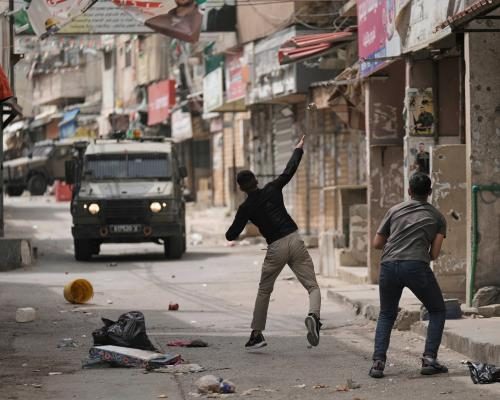
Maj Gen Avi Bluth, Israel's army commander in the West Bank, said troops were "killing like we haven't killed since 1967" in remarks reported by Haaretz from a recent closed forum. His account included 42 Palestinian stone-throwers shot last year and different treatment for Jewish settlers.
Stone-throwers face different rules, commander says
Bluth, head of the army's central command, hasn't denied the authenticity of the newspaper's account. The Israel Defense Forces did not respond to a request for comment, according to the report. There's been no denial from the commander so far. Originally reported by The Guardian.
According to Haaretz, Bluth described troops shooting Palestinian stone-throwers on West Bank roads, including fatal shootings, and classified stone-throwing as terrorism. But he said soldiers didn't shoot Jewish settler militants for the same conduct.
Recalling an incident in which army gunfire wounded a settler throwing stones at motorists, Avi Bluth said it caused a public "ruckus". He explained: "Any such incident has very serious consequences from a societal perspective," and acknowledged: "Yes, it involves discrimination."
The distinction extends beyond encounters on roads. Palestinians in the West Bank are subject to military law and extended detention without trial, while Israelis are judged by civilian courts. Bluth was born in a West Bank settlement and educated at a religious military academy in the occupied territory.
Barrier shootings described as a deterrent
The commander also described loosening restrictions on soldiers confronting Palestinians attempting to cross the separation barrier into Israel for work. His reported explanation presented gunshot wounds as a means of discouraging future crossings, rather than solely responding to an immediate threat.
"At the [separation barrier], it is currently permitted to detain a suspect by shooting him at the knee or below to create 'barrier awareness'," Avi Bluth said, according to Haaretz.
Avi Bluth added: "There are a lot of 'limping monuments' in Palestinian villages of those who tried to [cross the barrier], so there is a price being paid," describing the injuries as a deterrent. He justified the rules by describing each illegal Palestinian worker as a "potential terrorist".
Haaretz challenged that reasoning in an editorial, describing the distinction between Palestinian and Jewish stone-throwers as an apartheidist approach. The newspaper questioned why the commander considered the societal consequences of shooting settlers but not the consequences of disabling Palestinians seeking work across the barrier.
A 1967 comparison against mounting West Bank deaths
Bluth placed the operations within what he portrayed as a survival-of-the-fittest struggle. The comparison reached back to the war against Arab states in 1967, when Israel occupied the West Bank and Gaza.
"If someone comes to kill you, kill them first is the norm in the Middle East, so we're killing like we haven't killed since 1967," Avi Bluth said, according to the newspaper's account. Thousands of Palestinians were killed during the second intifada, from 2000 to 2005.
According to UN figures, Israeli forces and settlers killed 230 Palestinians in the West Bank in 2025. Violence and intimidation by settlers have escalated since the 7 October 2023 Hamas attack on Israel and the ensuing war in Gaza.
That campaign has sought to drive Palestinians from their land, with settlers routinely assisted by the Israeli army. Its ranks increasingly include soldiers and officers drawn from settlements, sharpening questions about the military's role in protecting Palestinians from attacks while enforcing restrictions against them.
Warning of an uprising over settler attacks
Days earlier, Haaretz reported another warning from Bluth: violence by extremists known as "hilltop youth" could ultimately provoke an uprising.
"These people don't see Arabs as human beings and think it's possible to burn people alive, to burn houses down with their occupants inside, and unfortunately, they do this frequently," Avi Bluth said.
The warning exposes a contradiction between his assessment of settler attacks and the different enforcement standards he described. Haaretz accused the army of working alongside settlers carrying out daily attacks.
Avi Bluth said "it's almost a miracle that the Palestinians are still indifferent" but warned they "won't remain indifferent indefinitely". His warning leaves the prospect of a West Bank uprising hanging over the policies he described.
Originally reported by The Guardian. View original.