
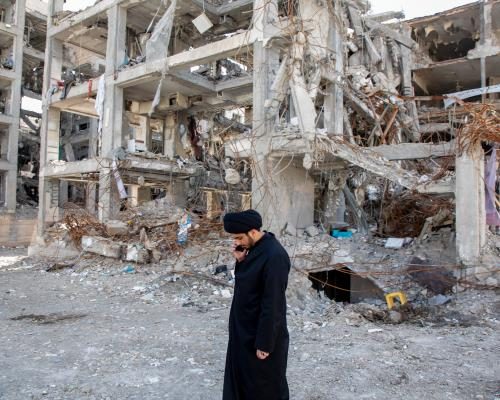
The Middle East stands on a precipice as Iran has formally rejected a U.S. ceasefire proposal, escalating tensions just before President Donald Trump's deadline. With threats to destroy key Iranian infrastructure looming, the geopolitical landscape remains fraught with uncertainty. Iran's refusal to accept a temporary ceasefire reflects deep-seated concerns over its national security and future attacks.
Iran's Firm Stance on Ceasefire Proposal
Iran's rejection of a ceasefire deal was reported by the state news agency IRNA, which confirmed earlier reports that diplomatic talks had stalled ahead of Trump's ultimatum. The Iranian government communicated its response to Pakistan, although the specific details of the U.S. proposal remain undisclosed. According to IRNA, Iran's response was outlined in ten points, emphasizing the need for a conclusive end to hostilities rather than a temporary solution. Originally reported by The Guardian.
As tensions escalated, Iran reiterated demands that included an end to regional conflicts, a protocol for safe passage through the critical Strait of Hormuz, reconstruction assistance, and the lifting of economic sanctions. The New York Times reported that Iran is also seeking guarantees against future attacks, especially concerning Israeli strikes on its ally Hezbollah in southern Lebanon.
Trump's Ultimatum and Financial Market Reactions
President Trump, unwavering in his approach, stated he was "not at all" concerned about potential war crimes associated with his threats against Iran. Speaking from the White House, he declared that if Iran failed to comply with the demands by 8 PM ET on Tuesday, he would order the destruction of every bridge and power plant in the nation. "You know what's a war crime? Having a nuclear weapon," he remarked, indicating a stark view of the ongoing conflict.
As the deadline looms, global markets reacted with volatility. Oil prices surged, with West Texas Intermediate reaching $115 per barrel, its highest in a month, while Brent crude approached $111. Investors are grappling with the prospect of supply disruptions in the Strait of Hormuz, through which approximately 20% of the world's crude and gas transit. "Financial markets are oscillating in a narrow, uneasy range as traders sized up the countdown to Donald Trump's Iran deadline," noted Stephen Innes from SPI Asset Management.
Military Escalations and Humanitarian Concerns
The situation further deteriorated with reports of Israeli military strikes against Iranian targets. On Monday, a wave of attacks reportedly killed more than 25 individuals in Iran, prompting retaliatory missile fire from Tehran aimed at both Israel and its Gulf Arab neighbors. Such actions have raised alarms about a wider regional conflict, with casualties reported on both sides.
In the Gaza Strip, tensions have also flared, as an Israeli airstrike killed at least ten people near a school housing displaced Palestinians. The World Health Organization has suspended medical evacuations from Gaza to Egypt following the killing of a WHO contractor, highlighting the ongoing humanitarian crisis exacerbated by the conflict.
International Diplomatic Efforts Stumble
Amid the chaos, international diplomatic efforts appear to be faltering. The United Nations Security Council is expected to vote on a resolution to protect commercial shipping in the Strait of Hormuz, though the proposal has been significantly watered down due to opposition from China, which has veto power. This reflects a broader struggle within the international community to address the escalating crisis effectively.
As the situation develops, the potential for further military engagement looms large. Trump's rhetoric, coupled with Iran's steadfast stance, suggests that peace remains elusive. With the deadline now upon us, observers worldwide are bracing for the potential fallout from this escalating conflict.
As the clock ticks down to Trump's ultimatum, the implications for the region and global markets remain profound. The interplay between military action, economic stability, and diplomatic negotiations will be crucial in determining the future trajectory of this conflict. Stakeholders on all sides are poised for what could be a pivotal moment in Middle Eastern geopolitics.
Originally reported by The Guardian. View original.