
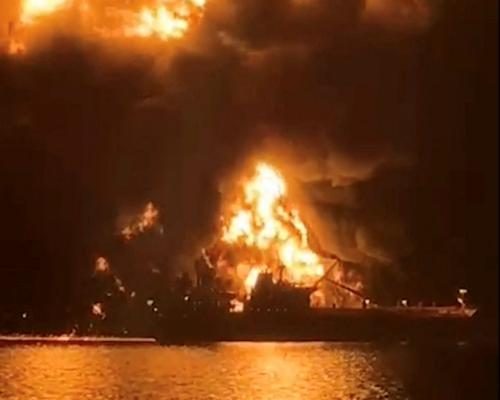
In a significant escalation of hostilities in the Middle East, Iran has intensified its attacks on vital energy infrastructure, triggering widespread disruptions in oil markets. A recent assault on Iraq's Basra port resulted in at least one fatality and prompted the shutdown of the country's oil terminals, according to officials. Farhan al-Fartousi, director general of the General Company for Ports of Iraq, confirmed the incident in a statement published by the state-run Iraqi News Agency. The attack targeted a vessel involved in a ship-to-ship oil transfer, with the specifics of the strike-whether executed by drone or missile-still under investigation. Rescuers reported recovering one body and assisting 38 others following the incident.
Bahrain and Oman Respond to Iranian Aggression
As tensions escalate, Bahrain's government urged residents in three districts of Muharraq to stay indoors following an Iranian assault on fuel tanks. The Interior Ministry advised citizens to close windows and ventilation systems to avoid exposure to smoke from ongoing firefighting efforts. Meanwhile, Oman took precautionary measures by relocating all vessels from its main oil export terminal at Mina Al Fahal, situated near the strategic Strait of Hormuz. These developments underscore the growing regional instability as Iran continues its aggressive campaign against energy assets. Originally reported by The Guardian.
Global Oil Prices Surge Amid Crisis
The ongoing conflict has led to significant volatility in global oil prices. Earlier this week, prices surged to approximately $120 per barrel before settling around $90. However, the renewed threats to supply chains have again driven prices higher. Market analysts are concerned that oil could reach $200 per barrel if disruptions continue. In a bid to stabilize the market, the U.S. government announced it will release 172 million barrels from its strategic petroleum reserve. This release is part of a broader 400 million barrel initiative agreed upon by the International Energy Agency, aimed at mitigating the impact of the war on global oil prices.
Humanitarian Crisis Unfolds in Lebanon
The conflict's ramifications extend beyond economic turmoil, with reports of a growing humanitarian crisis in Lebanon. An Israeli military campaign has targeted Hezbollah positions in southern Beirut following an attack that involved the firing of dozens of rockets. The Israeli Defense Forces (IDF) have described their operations as a large-scale response, resulting in over 570 confirmed deaths, including at least 83 children, according to UNICEF data. The violence has displaced roughly 750,000 individuals, exacerbating the humanitarian situation as aid organizations scramble to meet the needs of those affected.
U.S. President Donald Trump, during a rally in Kentucky, asserted that the U.S. is not finished with its military operations, claiming that the country has struck Iran harder than any nation in history. He expressed a desire to conclude the conflict efficiently, stating, "We don't want to leave early do we? We've got to finish the job." Despite Trump's assurances, U.S. intelligence suggests that Iran's leadership remains stable and is not at immediate risk of collapse. Reports indicate that the Iranian regime retains control over its public and has a significant capacity to respond to external pressures.
Amidst the chaos, Iran's UN ambassador condemned a recent Security Council resolution calling for an end to its attacks on Gulf nations, labeling it an "injustice" against Iran. He contended that Iran is a victim of aggression, emphasizing the need to address the root causes of the conflict rather than imposing unilateral sanctions.
As the situation continues to evolve, analysts predict further volatility in energy markets and heightened instability across the Middle East. With Iran's determined offensive against oil and transport facilities, stakeholders in the energy sector are bracing for continued disruptions. The international community watches closely as the implications of this conflict unfold, with global energy security hanging in the balance.
Originally reported by The Guardian. View original.