
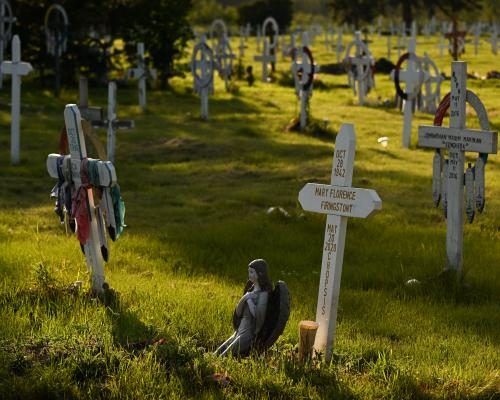
Indigenous survivors of Canada's residential school system face an urgent battle as all documents from their testimonies are set for destruction in 2027. Survivors like Cheryle Dreaver, who learned of her mother Ivy's traumatic experiences in 2008, are now racing against time to ensure these critical accounts of abuse are not lost forever.
Testimonies Uncover a Dark Chapter in Canadian History
Cheryle Dreaver first learned of her mother's harrowing experiences as a child when Ivy Dreaver testified in a Winnipeg courtroom in 2008. Ivy, among tens of thousands of Indigenous people, shared her story of sexual, physical, and mental abuse endured at a residential school, a revelation that left Cheryle in shock. "At that time.. I didn't know those things had happened to her until that very day," she recalled. "I was in shock.. there was a lot of abuse." The testimonies of approximately 38,000 former students contributed to what has been termed a policy of "cultural genocide," ultimately leading to the largest class-action lawsuit in Canadian history, marking a significant moment in the nation's reckoning with its colonial past. Originally reported by The Guardian.
However, nearly two decades later, all documents stemming from these hearings-including critical first-hand accounts detailing systemic harm and the deaths of Indigenous children-are scheduled for destruction. The deadline, set for September 19, 2027, was established nearly a decade ago, yet many First Nation communities, advocates, and academics argue the federal government has done little to inform survivors that their files are at risk.
Government's Obligation to Inform Survivors
Heather George, executive director of the Woodland Cultural Centre, an Indigenous-owned educational facility in southern Ontario, emphasized the government's responsibility to reach out to survivors. "The responsibility of reaching out to these survivors.. is something the federal government should be taking on," she stated, highlighting a consistent pattern of the government neglecting its obligations.
In 2017, Canada's Supreme Court ruled that testimonies must be destroyed after a decade, citing that claimants expected confidentiality when they agreed to testify. Now, survivors and their families have until the 2027 deadline to request the preservation of their documents. Notably, only former students can make these requests, meaning that if a survivor has passed away, their documents are guaranteed to be eliminated.
Systemic Abuse in Residential Schools
Between the late 19th century and the 1990s, over 150,000 Indigenous children were forcibly taken from their families and placed in Christian residential schools aimed at eradicating First Nations cultures. Survivors have recounted experiences of routine physical mistreatment, neglect, starvation, and rampant sexual abuse, corroborated by findings from a governmental truth and reconciliation commission. Following numerous lawsuits by former students, the federal government established a settlement in 2006 for those who came forward with their claims.
Ivy Dreaver attended the Prince Albert school in Saskatchewan from grades one to six in the 1960s. In her testimony, she recounted being brutally beaten for speaking her native Cree language, humiliated publicly for wetting the bed, and sexually abused by a priest under the guise of piano lessons at just eight years old. Cheryle Dreaver only discovered last year that her mother's evidence was set for destruction, prompting her to act quickly to safeguard the files.
Calls for National Archiving Efforts
Kimberly Murray, the former executive director of the Truth and Reconciliation Commission, expressed dismay over the impending destruction of these records. "There were ways for us to protect those records and the confidentiality of those records without destroying them," she said. Despite the Supreme Court ruling being final, Murray argues that erasing files containing evidence of genocide contradicts international law.
As a law professor at Queen's University in Ontario, she stressed that survivors were never consulted about the future of their records when they testified, nor was there a plan to use their testimonies for further investigations into the crimes committed at these schools. Meanwhile, journalist Connie Walker, from Okanese First Nation in Saskatchewan, highlighted the difficulty in accessing information on crimes at residential schools, noting her own investigation revealed over 220 allegations of sexual abuse at a single school.
With just 18 months until the destruction deadline, the federal government has announced it is preparing materials to raise awareness about the September 2027 date. However, a spokesperson for Canada's Ministry for Crown-Indigenous Relations and Northern Affairs reiterated that the government cannot overlook the Supreme Court's "final orders."
Originally reported by The Guardian. View original.