
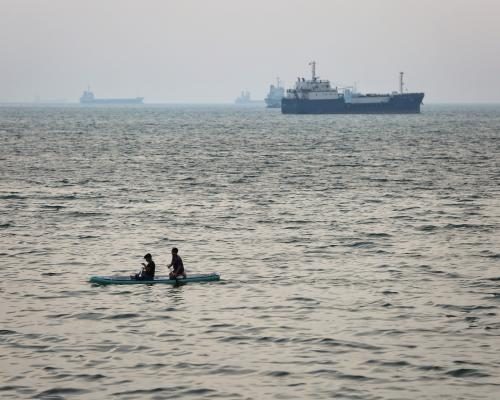
Iranian authorities have declared that reopening the vital Strait of Hormuz is "impossible" amid ongoing tensions andceasefire violations involving the United States and Israel. The situation escalated recently when Iranian forces seized two ships within the strait, a crucial maritime passage through which approximately 20% of the world's oil and liquefied gas typically flows. The standoff raises significant concerns about the future of peace negotiations, which have stalled amid escalating hostilities.
Seizures Highlight Escalating Maritime Tensions
The Iranian Islamic Revolutionary Guard Corps (IRGC) reported on Wednesday that they had intercepted two vessels attempting to navigate the Strait of Hormuz, asserting that the ships were trying to exit the waterway covertly. The vessels, identified as the Panama-flagged MSC Francesca and the Liberia-flagged Epaminondas, were taken to an Iranian port. The latter is operated by Greece, and the Greek Foreign Minister confirmed an attack on a Greek-owned cargo ship. Originally reported by The Guardian.
In a troubling incident on Wednesday, a UK-based maritime security monitor reported that an Iranian gunboat fired upon a vessel, causing significant damage to its bridge. This marks the first instance of Iran seizing ships since the outbreak of conflict on February 28. The US has also engaged in similar aggressive actions, including the seizure of an Iranian cargo vessel and boarding an Iranian oil tanker in the Indian Ocean, further fueling tensions in the region.
Political Responses and Implications
Mohammad Bagher Ghalibaf, the Speaker of the Iranian Parliament, stated late Wednesday that the continued US and Israeli military actions, which he labeled as "flagrant" violations of the ceasefire, make any reopening of the strait impossible. He criticized the US naval blockade, calling it "the hostage-taking of the world's economy" and accused both nations of pursuing aggressive policies that have not yielded their desired outcomes. Ghalibaf expressed on the social media platform X that the aggressive tactics employed by the US and Israel would not succeed in achieving their goals.
The rhetoric from Iranian officials comes amid reports of new proposals from Washington, suggesting a potential for dialogue, albeit complicated by the ongoing hostilities. Pakistan has attempted to mediate, although a luxury hotel in Islamabad prepared for negotiations remained empty as neither side took definitive steps toward talks.
Global Economic Fallout
The closure of the Strait of Hormuz has reverberated globally, exacerbating fuel shortages and economic instability. The strait is a critical artery for energy supplies, and its blockage has led to increased prices and inflation, particularly affecting nations in Asia that rely heavily on Gulf oil. In response to the crisis, Germany reduced its economic growth forecast for 2026 to 0.5%, while Greece announced an additional €500 million (£434 million) in aid to support households and farmers facing rising costs.
Greek Prime Minister Kyriakos Mitsotakis remarked on the nation's economic resilience, despite acknowledging the pressures from escalating prices on everyday essentials. He stated, "The nation's economy is holding up and doing better than expected. However, the stress of the supermarket, the expenses of children, more expensive fuel and the care of the elderly remain."
Stalled Peace Efforts and Diplomatic Strain
The international diplomatic landscape surrounding the Iranian conflict continues to evolve, yet significant challenges remain. Following the US withdrawal from the nuclear agreement during Donald Trump's first term, tensions have only escalated. Trump's recent remarks hinted at a volatile approach, as he expressed a readiness for military action while emphasizing the need for a blockade.
Amidst this backdrop, the head of the UN maritime agency has called for assistance for thousands of seafarers stranded in the Gulf due to the closure of the Strait of Hormuz. According to the International Maritime Organization (IMO), approximately 20,000 seafarers and 2,000 ships are currently trapped, highlighting the humanitarian aspect of this escalating crisis.
As the situation develops, the potential for renewed negotiations remains uncertain, given the deep-seated mistrust and ongoing military actions. With both sides entrenched in their positions, the geopolitical stakes continue to rise, exacerbating global economic challenges.
Originally reported by The Guardian. View original.