
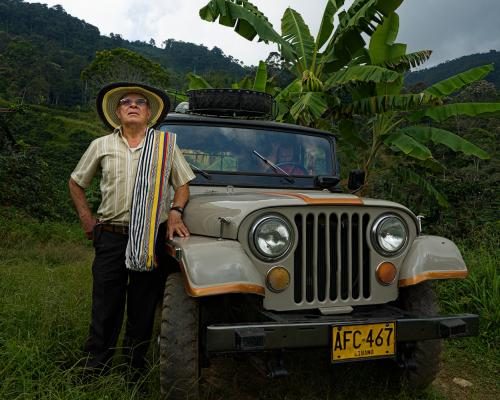
Colombia's coffee industry, renowned for its rich heritage, finds itself in a puzzling predicament as farmers experience historic harvests coinciding with soaring global coffee prices. Despite record highs for the second consecutive year in 2025, many coffee growers, like Mary Luz Pérez Arrubla and her brother Rodrigo from Tolima, struggle to find enough workers to pick their crops, resulting in significant losses.
Historic Harvests Amid Unprecedented Prices
The Pérez Arrubla family, fourth-generation coffee farmers situated on the Andean slopes near Líbano, has reaped the benefits of a record harvest. Global coffee prices surged to unprecedented levels, driven by severe US tariffs on Brazil and Vietnam, the two largest coffee producers, coupled with poor yields attributed to the El Niño phenomenon. This cyclical weather pattern has wreaked havoc on coffee production in these countries, while Colombia's high-altitude coffee-growing regions thrived under the same conditions. Originally reported by The Guardian.
However, this bountiful harvest has not translated into success for all. The family reported losing approximately 10% of their crop due to a labor shortage. "We could not stop. All week, every week, for two-and-a-half months, we picked coffee," Mary Luz Pérez Arrubla stated, lamenting that much of the coffee ended up on the ground rather than in bags.
Climate Challenges and Labor Shortages
Colombia's coffee industry is at a critical juncture, grappling with the consequences of climate change and rural depopulation. Average temperatures in the Andes have increased by about 1.2 degrees Celsius since the 1980s, while sunlight hours have decreased by nearly 19%. Farmers are witnessing a shift in weather patterns, resulting in increased droughts, heavier rains, and a rise in pests and diseases. Research indicates that by 2041 to 2060, coffee yields could decline by 8% in lower-altitude areas, while higher elevations may see a rise of around 16%. This trend compels farmers to migrate their cultivation further uphill.
Yet, while some farmers adapt to these challenges, many remain unable to invest in necessary innovations. In the past generation, the workforce in Colombia's coffee sector has dwindled by 25%, with the proportion of workers over the age of 60 more than doubling, according to the National Coffee Growers Federation. Economic disparities between rural and urban areas continue to drive young people away from farming.
Desperate Measures to Hire Workers
The scramble to recruit coffee pickers has reached a desperate level. Although there are no national estimates for the percentage of the 2025 harvest left unpicked, labor shortages have been increasingly reported across the industry. Wilder Gomez, the Pérez Arrubla family's farm manager, described the difficulty of finding laborers, noting that he often starts his day at 6 AM in Líbano's town square, trying to hire 10 to 20 workers when he actually needs 30. Those he manages to employ often leave for better opportunities elsewhere.
To attract workers, the family has raised wages, but it's proving insufficient. "It isn't just about the wage," Jacqueline Mazza, a labor market expert at Johns Hopkins University, explained. Factors such as access to services, opportunities for growth, and job stability draw laborers to urban areas over the uncertainty of rural work.
Mechanization and Technological Challenges
While other countries like Brazil have turned to mechanization to combat labor shortages, Colombia's mountainous terrain complicates this solution. Yinson Javier Díaz, an agronomist for the growers' federation, pointed out that Brazil's flat fields allow machines to operate easily, but Colombia's diverse slopes present unique challenges. Moreover, machines that shake coffee cherries do not differentiate between ripe and unripe fruit, leading to waste.
Innovative technologies are emerging, such as eco-friendly mills reducing water and labor costs, AI-powered sorting machines, and drones for precise pesticide application. However, the high costs of these technologies put them out of reach for most Colombian farmers. Díaz noted that less than 5% of growers can afford to invest in the new mills, which start at 22 million Colombian pesos (approximately £4,150).
As Colombia's coffee industry navigates this complex landscape, the future remains uncertain. Farmers are determined to adapt, but without adequate labor and resources, the challenges ahead are daunting.
Originally reported by The Guardian. View original.